Unprecedented: NYC Bans AI in Classrooms for Young Kids — Here’s Why
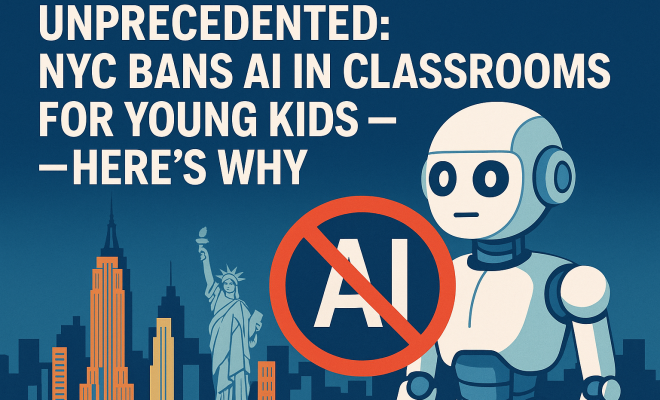
The integration of artificial intelligence into our daily lives is happening at a dizzying pace, and it was only a matter of time before it became a hot topic in education. But what happens when a major school district decides to hit the brakes, especially for its youngest learners? That’s precisely what’s unfolding in New York City, where public schools have announced a significant, one-year moratorium on student-facing generative AI for grades K-8. This isn’t just a minor tweak; it’s a bold move that’s sparking intense debate among parents, educators, and tech enthusiasts worldwide, forcing us all to consider the true implications of AI in classrooms.
Effective for the 2026-2027 school year, this prohibition means that younger students won’t have direct exposure to generative AI tools. High schoolers, however, will see limited, supervised use, alongside mandatory AI literacy modules. It’s a nuanced approach, to be sure, reflecting deep-seated concerns about how these powerful tools might impact children’s cognitive and emotional development. The central question many are grappling with is whether the promise of personalized learning outweighs the potential risks to critical thinking and the invaluable human connection in education. Let’s dig into the core reasons behind this decision and the broader context of AI in classrooms.
1. Protecting Cognitive and Emotional Development: The NYC Stance
New York City Public Schools didn’t make this decision lightly. Their primary concern, and frankly, a very valid one, revolves around the cognitive and emotional development of younger children. Think about it: generative AI, like ChatGPT, can produce essays, solve complex math problems, and even create art with astonishing speed. While this might seem like a futuristic boon for older students, for a kindergartner or an eighth grader, the implications are far less clear.
The worry is that constant reliance on AI could lead to what some experts call ‘cognitive off-loading.’ This means students might outsource their thinking processes to AI, rather than developing their own problem-solving skills, critical analysis, and creative thought. Imagine a child who always has an AI write their stories; will they ever truly learn to craft a narrative on their own? Or a student who uses AI to solve every math problem; will they ever grasp the underlying principles? The district is essentially saying, ‘Let’s give our youngest learners the space to develop these foundational skills organically, without the potential crutch of AI, before introducing such powerful tools.’
2. The ‘Cognitive Off-Loading’ Conundrum: A Deeper Dive
The concept of cognitive off-loading isn’t new, but AI supercharges it. Historically, students might have off-loaded memory to calculators or encyclopedias. Now, AI can off-load entire creative and analytical tasks. The concern isn’t just about cheating, though that’s certainly part of the discussion. It’s about the very process of learning itself.
When we struggle with a problem, when we wrestle with an idea, that’s often when the deepest learning happens. Our brains form new connections, we develop resilience, and we truly internalize concepts. If AI steps in to solve these struggles too quickly, too efficiently, are we robbing students of these crucial growth opportunities? This isn’t to say AI can’t be a valuable tool, but for developing minds, the balance between support and independent effort is incredibly delicate. The NYC moratorium reflects a desire to err on the side of caution, ensuring that foundational thinking skills are firmly established before students are exposed to tools that could bypass that essential development.
3. Erosion of Critical Thinking Skills: A Core Fear
Hand-in-hand with cognitive off-loading is the fear of eroding critical thinking skills. Critical thinking isn’t just about knowing facts; it’s about evaluating information, questioning assumptions, identifying biases, and forming reasoned judgments. These are skills that are developed through practice, through debate, through grappling with complex ideas and diverse perspectives.
If students rely on AI to generate answers or arguments, they might become passive consumers of information rather than active interrogators. How do they learn to spot logical fallacies if an AI always presents a perfectly structured, albeit potentially flawed, argument? How do they develop their own voice and perspective if AI can articulate thoughts far more eloquently? The argument from proponents of the moratorium is that these skills are too vital to risk, especially in the formative years. They need to be honed through genuine intellectual engagement, not through the instant gratification of AI-generated content.
4. The High School Exception: Supervised Use and AI Literacy
It’s important to note that the NYC decision isn’t a blanket ban on AI in classrooms across the board. High school students will still have limited, supervised exposure to generative AI. This distinction is key. By high school, students are generally considered to have a more developed cognitive framework, a stronger grasp of foundational skills, and a greater capacity for critical evaluation.
Crucially, this limited use will be coupled with mandatory AI literacy modules. This is an intelligent approach, recognizing that ignoring AI isn’t an option for older students who will enter a world steeped in it. The goal here isn’t to shield them from AI, but to teach them how to use it responsibly, ethically, and effectively. They’ll learn its capabilities, its limitations, how to prompt it effectively, and perhaps most importantly, how to critically assess the information it provides. It’s about empowering them to be masters of the tool, rather than being mastered by it. (See: CDC on mental health in youth.)
5. The Social Media Firestorm: Parents, Educators, and the Debate
Naturally, a decision of this magnitude has ignited a passionate social media debate. On one side, many parents and educators are applauding NYC’s caution. They express relief that their children’s foundational learning won’t be immediately subjected to what they see as an untested and potentially harmful technology. They echo concerns about creativity, critical thinking, and the invaluable human element of teaching and learning. For more context, see AI Revolution in EdTech.
On the other side, there are voices arguing that this is a step backward, that it denies students access to cutting-edge tools that will define their future. Proponents of AI in classrooms often highlight its potential for personalized learning, catering to individual student needs in ways a single teacher simply cannot. They point to AI’s ability to provide instant feedback, adapt to different learning styles, and free up teachers from administrative tasks, allowing them to focus more on direct instruction and connection. This divergence of opinion underscores the complexity of integrating AI into such a fundamental societal institution.
6. Personalized Learning vs. Human Connection: A Balancing Act
One of the most compelling arguments for AI in education is its potential for truly personalized learning. Imagine an AI tutor that understands a student’s strengths and weaknesses, adapts lessons in real-time, and provides targeted practice. This could be revolutionary, especially for students who struggle or those who need advanced challenges. In theory, AI could make education far more equitable and effective.
However, the counter-argument, and a significant factor in NYC’s decision, is the irreplaceable value of human connection. Learning isn’t just about absorbing information; it’s about interaction, collaboration, empathy, and mentorship. A teacher’s ability to inspire, to understand a student’s emotional state, to foster a sense of community in the classroom—these are aspects AI simply cannot replicate. The debate isn’t about choosing one over the other, but finding the right balance where AI enhances, rather than replaces, these crucial human elements.
7. Addressing Teacher Skill Shortages: The Global Context
While Western nations like the US grapple with the ethical implications of AI in classrooms, other parts of the world, notably developing countries like India, view AI through a slightly different lens. For regions facing significant teacher skill shortages and massive student populations, AI is seen as a potential lifesaver. It could democratize access to quality education, provide supplementary instruction where trained teachers are scarce, and help bridge educational gaps.
In such contexts, the immediate benefits of AI in delivering content and basic instruction might outweigh the longer-term developmental concerns, at least initially. This highlights a crucial point: the ‘AI in classrooms’ debate isn’t monolithic. The solutions and priorities will vary significantly based on local needs, resources, and educational infrastructure. What’s right for a well-resourced urban district in NYC might not be the optimal approach for a rural school in India struggling with a lack of qualified educators.
8. The Future of Learning: Navigating the AI Landscape
The New York City Public Schools’ moratorium is a significant moment, a pause in the headlong rush to integrate every new technology. It forces us to ask critical questions about what we value most in education. Is it efficiency? Personalization? Or is it the development of fundamental human skills like creativity, critical thinking, and social-emotional intelligence?
Ultimately, AI is here to stay, and its presence in education will only grow. The real challenge isn’t whether to use AI, but how to use it wisely. This means developing thoughtful policies, investing in robust AI literacy programs for both students and teachers, and continually evaluating the impact of these tools on learning outcomes and student well-being. The NYC decision is a powerful reminder that sometimes, taking a deliberate step back allows us to see the path forward with greater clarity, ensuring that technology serves humanity, rather than the other way around. We’re still very much in the early stages of understanding AI’s full impact, and careful, contextual approaches like this one will be crucial for navigating its potential.
9. Ethical Considerations and Bias in AI: A Crucial Teaching Point
Beyond the developmental impacts, the ethical dimensions of AI in classrooms present another layer of complexity that NYC is implicitly addressing with its moratorium. AI systems are trained on vast datasets, and if those datasets contain biases—which many do, reflecting societal inequalities—then the AI will perpetuate and even amplify those biases. For younger students, who are still forming their understanding of the world, exposure to biased AI could be particularly problematic, potentially reinforcing stereotypes or presenting a skewed view of reality.
Consider AI that generates historical essays. If the training data heavily favors one perspective, the AI’s output might omit crucial narratives or marginalize certain voices. Teaching high schoolers about these inherent biases, how to identify them, and how to prompt AI to mitigate them becomes a critical part of AI literacy. But for a K-8 student, discerning such nuances is a huge ask. The moratorium allows time to develop more equitable AI tools and, importantly, to craft curricula that explicitly teach about AI ethics, algorithmic bias, and responsible data use when students are cognitively ready to grasp these complex ideas. (See: AP News on education technology.)
10. Data Privacy and Security Concerns: Protecting Student Information
Another unspoken but significant factor in the debate around AI in classrooms, especially for younger students, is data privacy and security. Generative AI tools, particularly those offered by third-party vendors, often collect and process vast amounts of user data. For adults, navigating terms of service and understanding data usage policies is already challenging. For children, it’s virtually impossible.
School districts have a legal and ethical responsibility to protect student information. The Children’s Online Privacy Protection Act (COPPA) in the US, for instance, sets strict rules for online services collecting data from children under 13. Integrating AI tools, especially those that might record interactions or analyze student input, introduces new vulnerabilities. NYC’s pause could be seen as a necessary period to thoroughly vet AI platforms for robust privacy protections, ensure compliance with relevant regulations, and establish clear guidelines for data handling. This proactive stance aims to prevent potential breaches or misuse of sensitive student data before widespread adoption. For more context, see Urgent Demand for AI Learning Architects.
11. Teacher Training and Professional Development: A Prerequisite for Effective AI Integration
Implementing AI effectively in classrooms isn’t just about giving students access to tools; it’s fundamentally about empowering teachers to use them well. This requires significant investment in teacher training and ongoing professional development. Without adequate preparation, even the most advanced AI tools can become distractions or simply go unused.
Teachers need to understand not only how AI works but also its pedagogical applications, its limitations, and how to integrate it thoughtfully into their existing curricula. They need to learn how to design assignments that leverage AI without sacrificing critical thinking, how to identify when students are over-relying on AI, and how to teach AI literacy effectively. The NYC moratorium offers a vital window for the district to develop comprehensive training programs for its educators, ensuring that when AI is eventually rolled out more broadly, teachers are equipped to maximize its benefits and mitigate its risks. This proactive approach acknowledges that technology alone doesn’t transform education; skilled educators do.
12. The “Human-in-the-Loop” Principle: Ensuring Teacher Oversight
A central tenet for successful AI integration in education, particularly for younger learners, is the “human-in-the-loop” principle. This means that AI should always serve as a tool to assist, not replace, human judgment and interaction. Teachers remain the ultimate arbiters of learning, providing context, emotional support, and the nuanced understanding that AI currently lacks.
For high schoolers in NYC, supervised use of AI aligns perfectly with this principle. Teachers will guide students, model appropriate use, and help them critically evaluate AI-generated content. This oversight is crucial for preventing misuse and ensuring that AI complements, rather than detracts from, the educational experience. For K-8, the difficulty of maintaining this “human-in-the-loop” for every generative AI interaction, coupled with the developmental concerns, likely contributed to the moratorium. It’s a recognition that younger students need more direct human guidance in their learning journey, and AI, in its current generative form, might make that oversight more challenging for teachers.
13. Long-Term Societal Impact: Preparing Students for an AI-Driven World
While the immediate concerns about cognitive development and critical thinking are paramount, the NYC decision also subtly touches upon the long-term societal impact of AI. Our students will enter a world where AI is ubiquitous, transforming industries, jobs, and daily life. Therefore, education must evolve to prepare them for this reality.
The goal isn’t to shield students from AI forever, but to ensure they develop the foundational skills and ethical frameworks to navigate it successfully. This includes not just using AI, but understanding its underlying principles, its limitations, and its societal implications. By taking a measured approach, NYC aims to ensure that its students are not merely consumers of AI, but thoughtful, ethical creators and critical evaluators of AI in the future. This long-term vision requires a curriculum that adapts thoughtfully, not impulsively, to technological shifts.
Frequently Asked Questions (FAQ) about AI in Classrooms
Q1: What exactly is “generative AI” and why is it a concern?
Generative AI refers to artificial intelligence systems that can create new content, like text, images, code, or music, based on prompts. Examples include ChatGPT for text, DALL-E for images, or tools that compose music. The concern, especially for younger students, is that these tools can produce sophisticated outputs so easily that students might rely on them instead of developing their own fundamental thinking, writing, and creative skills. It bypasses the struggle and effort often essential for deep learning. (See: New York Times on AI in education.)
Q2: Why is New York City only banning it for K-8 and not high schoolers?
The distinction is primarily due to developmental differences. K-8 students are in crucial stages of developing foundational cognitive skills like critical thinking, problem-solving, and creative expression. The fear is that early, unsupervised exposure to generative AI could hinder this organic development. High schoolers are generally considered to have a more established cognitive framework, making them better equipped to use AI as a tool, with proper guidance, for research, brainstorming, or refining work, rather than as a replacement for fundamental thought processes.
Q3: What does “AI literacy” mean for students?
AI literacy is about understanding what AI is, how it works, its capabilities, and its limitations. For students, this means learning how to effectively prompt AI, how to critically evaluate the information it provides (since AI can “hallucinate” or produce biased content), and understanding the ethical implications of AI use, including data privacy and algorithmic bias. It’s about becoming responsible and discerning users of AI, not just passive recipients of its outputs.
Q4: Can AI help teachers, even if students aren’t directly using generative AI?
Absolutely! Many AI applications can significantly assist teachers with administrative tasks, lesson planning, and even creating differentiated learning materials. AI can automate grading for multiple-choice questions, generate quizzes, summarize lengthy articles for lesson preparation, or help teachers identify common student misconceptions. This frees up teachers to focus more on direct instruction, personalized feedback, and building relationships with students, enhancing the human element of teaching.
Q5: Is AI in classrooms primarily about cheating?
While cheating is a concern that often comes up in discussions about AI in classrooms, it’s far from the only or even the primary issue. The deeper concerns revolve around the potential impact on student learning processes: the erosion of critical thinking, creativity, and problem-solving skills if students rely too heavily on AI. For educators, it’s about preserving the integrity of the learning process itself, ensuring students are truly developing their own abilities.
Q6: What are the potential benefits of AI in education that proponents highlight?
Proponents often highlight AI’s potential for personalized learning, where AI can adapt lessons to individual student paces and learning styles, offering instant feedback and targeted support. It could make education more equitable by providing resources to students who might not otherwise have access. AI can also handle repetitive tasks, freeing up teachers’ time, and offer advanced challenges or supplementary materials for gifted students.
Q7: How does the NYC decision compare to other school districts or countries?
The NYC decision reflects a cautious approach, leaning towards developmental protection. Other districts and countries vary widely. Some, particularly in developing nations with teacher shortages, are embracing AI more rapidly to address immediate access gaps. Others are experimenting with AI in specific subjects or grade levels. The global landscape is highly diverse, reflecting different priorities, resources, and cultural contexts. There’s no single, universally agreed-upon best practice yet, which makes NYC’s pause particularly noteworthy.
Q8: What should parents do if they’re concerned about their child’s exposure to AI outside of school?
Parents play a crucial role in guiding their children’s technology use. Open conversations about AI, its capabilities, and its limitations are essential. Encourage critical thinking about information found online, regardless of its source. Model responsible technology use and set clear boundaries for screen time and AI tool usage at home. Many educational resources are becoming available to help parents understand and discuss AI with their children, fostering healthy digital citizenship.
Trending Now
Frequently Asked Questions
Why did NYC ban AI in classrooms for young kids?
NYC banned AI in classrooms for grades K-8 to protect the cognitive and emotional development of younger students. Concerns arose that reliance on generative AI tools could hinder critical thinking and the essential human connection in education.
What age groups are affected by the NYC AI ban?
The AI ban affects students in grades K-8, meaning children up to 13 years old will not have direct exposure to generative AI tools. High school students will have limited, supervised access along with mandatory AI literacy modules.
How does the AI ban impact high school students in NYC?
High school students in NYC will still have access to AI tools, but their use will be limited and supervised. They will also be required to complete AI literacy modules to understand the technology better.
What are the potential risks of AI in education?
Potential risks of AI in education include hindering critical thinking skills and emotional development in young learners. Experts worry that over-reliance on AI could diminish essential learning experiences and human interactions.
What are the arguments for and against AI in classrooms?
Proponents argue that AI can provide personalized learning experiences, while opponents highlight concerns over cognitive development and the loss of human connection. The NYC ban reflects these ongoing debates about the role of AI in education.
Have you experienced this yourself? We'd love to hear your story in the comments.