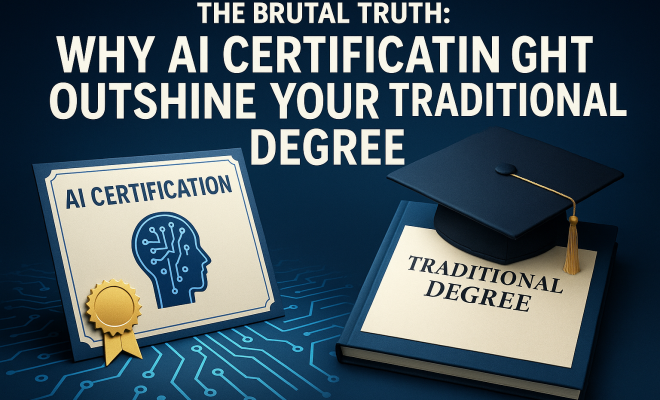
The Brutal Truth: Why AI Certification Might Outshine Your Traditional Degree
We’re living through an educational earthquake, aren’t we? It’s a seismic shift, and if you’re a college student or someone looking to stay relevant in the job market, you’re probably feeling the tremors. For years, the traditional four-year degree was the gold standard, the undeniable ticket to a good career. But then AI came along, like a technological tsunami, and suddenly, the ground beneath our feet feels less stable. What’s truly valuable now? Is it that hard-earned degree, or is it an AI certification that promises immediate, in-demand skills? This isn’t just an academic debate; it’s a career-defining question, especially when you consider the ongoing discussion around AI certification vs traditional degree.
The truth is, students aren’t waiting for institutions to catch up. They’re flocking to platforms like Coursera and Simplilearn, investing their time and money in upskilling programs. Why? Because employers are screaming for AI expertise, and the traditional curriculum, bless its heart, just can’t keep pace. This creates a fascinating tension, a real dilemma for anyone trying to navigate an increasingly AI-driven workforce. Let’s dig into seven crucial areas where this battle for relevance is playing out.
1. The Speed of Relevance: AI Certification vs. Traditional Degree Curricula
One of the most glaring differences between an AI certification and a traditional degree lies in their respective speeds of relevance. Think about it: how quickly does a university update its core curriculum? Often, it’s a bureaucratic process, taking years to approve new courses, acquire faculty, and integrate the latest technological advancements. By the time a new AI-focused degree program is fully established, the technology it teaches might already be partially obsolete.
AI certifications, on the other hand, are designed for agility. Edtech companies, unburdened by the same institutional inertia, can roll out new modules and update course content almost in real-time. This means that when you pursue an AI certification, you’re often learning the very latest tools, frameworks, and methodologies that are actively being used in the industry right now. This responsiveness is a massive advantage in a field as rapidly evolving as artificial intelligence, giving you a distinct edge in the job market.
2. Employer Demand: The Skills Gap and Immediate Needs
It’s no secret that there’s a significant skills gap in the AI sector. Companies, from tech giants to small startups, are desperate for talent that can implement, manage, and innovate with AI. They don’t necessarily care if you have a four-year degree in Computer Science if that degree didn’t equip you with practical, hands-on experience in machine learning, deep learning, or natural language processing. What they want are individuals who can hit the ground running.
This is where AI certifications truly shine. Many of these programs are developed in collaboration with industry leaders or are designed by practitioners who know exactly what skills are needed on the job. Employers see these certifications as a clear signal that a candidate possesses targeted, immediately applicable abilities. The focus isn’t just on theoretical knowledge, but on project-based learning and practical application, which is precisely what businesses are looking for to fill their urgent AI-related roles.
3. Cost-Effectiveness and Accessibility: Bridging the Financial Divide
Let’s talk money, because for many, this is a huge factor. A traditional four-year degree, especially from a reputable institution, can cost tens of thousands, if not hundreds of thousands, of dollars. Add to that the cost of living, lost income during study, and student loan interest, and you’re looking at a truly substantial investment. While the long-term ROI can be high, the upfront cost is a major barrier for many aspiring professionals.
AI certifications, by contrast, are often significantly more affordable. Many reputable programs can be completed for a few hundred to a few thousand dollars. This lower financial barrier makes high-quality AI education accessible to a much broader audience, democratizing access to in-demand skills. For those who already have a degree but need to reskill, or for individuals who can’t commit to a multi-year academic program, certifications offer a viable, cost-effective pathway to career advancement.
4. Specialization vs. Breadth: Tailored Skills for Specific Roles
A traditional degree, particularly at the undergraduate level, is designed to provide a broad educational foundation. You’ll take general education courses, explore various disciplines within your major, and develop critical thinking skills. This breadth is undoubtedly valuable, fostering well-rounded individuals and adaptable thinkers. However, when it comes to highly specialized fields like AI, this breadth can sometimes mean a lack of depth in the specific areas employers need most.
AI certifications are laser-focused. They’re built to impart specific skill sets required for particular roles – think Machine Learning Engineer, Data Scientist (with an AI focus), AI Developer, or AI Ethics Specialist. This specialization means that graduates of these programs often possess a deep understanding and practical proficiency in a narrow but highly in-demand area. For employers looking to fill a very specific technical role, a candidate with a specialized AI certification often stands out more than one with a general computer science degree that might only touch upon AI concepts. (See: AI's impact on education and jobs.)
5. Career Readiness and Entry-Level Woes: The AI Certification vs Traditional Degree Paradox
Here’s a troubling paradox that’s fueling the surge in AI certification enrollment: while AI adoption boosts overall hiring, it disproportionately favors senior roles. Recent studies have highlighted a concerning trend: a decline in junior, entry-level positions. This means that just having a traditional degree, even in a related field, might not be enough to land that crucial first AI job. Employers are looking for demonstrable skills, not just potential. For more context, see How to Secure High-Paying Jobs in Finance with AI Skills.
Students are acutely aware of this, and it’s driving them to seek out structured educational pathways to complement their formal degrees. An AI certification can act as a bridge over this entry-level chasm, providing the concrete, project-based experience that hiring managers are now expecting. It signals that you haven’t just learned about AI; you’ve actually built something with it, which is a powerful differentiator in a competitive market.
6. Lifelong Learning and Upskilling: The New Normal
The days of getting one degree and being set for life are long gone. In the age of AI, lifelong learning isn’t just a buzzword; it’s an economic imperative. The pace of technological change demands continuous upskilling and reskilling. A traditional degree provides a foundational education, but an AI certification is a perfect example of how professionals can continuously update their knowledge and remain competitive.
Many individuals already holding traditional degrees are pursuing AI certifications to pivot their careers, enhance their existing skill sets, or simply stay current. This trend underscores a fundamental shift: education is no longer a one-time event but an ongoing journey. In this context, the flexibility and targeted nature of AI certifications make them indispensable tools for professional development, providing a practical answer to the ongoing question of AI certification vs traditional degree in a dynamic career landscape.
7. Validation and Credibility: The Evolving Landscape of Recognition
Historically, a degree from an accredited university was the ultimate stamp of approval. It signified a rigorous, comprehensive education. While this remains true for many fields, the tech industry, and AI in particular, is increasingly valuing practical skills and demonstrable projects over traditional credentials alone. Companies like Google, Microsoft, and IBM offer their own AI certifications, and these carry significant weight because they’re backed by industry giants.
When an employer sees a candidate with a certification from a respected Edtech platform or a leading tech company, they recognize the specific competencies validated by that credential. It speaks directly to a candidate’s ability to perform specific tasks. While a traditional degree provides a broad foundation of credibility, an AI certification often provides more granular, job-specific validation that can be immediately relevant in the hiring process.
The Hybrid Approach: The Smart Play for the Future
So, is it truly an either or situation? An AI certification vs traditional degree? Not necessarily. For many, the most strategic path forward involves a hybrid approach. Imagine someone with a traditional degree in, say, business or psychology, who then augments their foundational knowledge with a specialized AI certification. This combination can be incredibly powerful.
A traditional degree provides critical thinking, communication skills, and a broader understanding of various domains – qualities that are essential for leadership and complex problem-solving. An AI certification then layers on the technical expertise, enabling that individual to apply their foundational knowledge in an AI-driven context. This dual approach offers the best of both worlds: the comprehensive development of a degree paired with the cutting-edge, in-demand skills of a certification. It’s about being well-rounded yet acutely specialized, adaptable yet immediately productive.
Navigating the Edtech Boom: Choosing the Right AI Certification
With the explosion of Edtech platforms, choosing the right AI certification can feel overwhelming. It’s not just about picking the cheapest or most popular option; it’s about aligning the certification with your career goals and ensuring its credibility. Look for programs that:
- Are offered by reputable platforms like Coursera, edX, Udacity, or Simplilearn.
- Have strong industry partnerships or are developed by leading tech companies (e.g., Google AI, IBM AI).
- Emphasize hands-on projects and practical application.
- Offer clear learning outcomes and pathways to specific job roles.
- Provide career services or community support.
- Have positive reviews and testimonials from alumni.
Do your homework. Check LinkedIn to see what certifications are held by people in roles you aspire to. The investment in time and money, even if smaller than a degree, still warrants careful consideration to ensure you’re getting the best return. (See: The rise of AI certifications.)
The Psychological Impact: Confidence and Empowerment
Beyond the tangible career benefits, there’s a significant psychological upside to pursuing AI certification. In a rapidly changing job market where the fear of automation and irrelevance looms large, acquiring new, in-demand skills can be incredibly empowering. It instills confidence, reduces anxiety about job security, and gives individuals a sense of control over their professional trajectory.
For students seeing their peers struggle to find entry-level roles, or for seasoned professionals feeling the pressure to adapt, taking proactive steps like earning an AI certification provides a tangible sense of progress and preparedness. It’s an investment in oneself, a declaration that you’re ready to meet the future head-on, regardless of whether you’re weighing an AI certification vs traditional degree. This personal empowerment is often overlooked but is a crucial component of long-term career satisfaction and resilience. For more context, see Why Ignoring AI Training Now Could Brutally End Your Career.
Expert Perspectives on the Shift
It’s not just students and employers grappling with this change; educators and industry leaders are also weighing in. Dr. Andrew Ng, a Stanford professor and co-founder of Coursera, has been a vocal proponent of online learning and specialized certifications. He often points out that universities, while excellent at providing foundational theory, struggle to adapt quickly enough to the pace of technological innovation, especially in fields like AI. He suggests that AI certifications can fill this gap, offering practical, up-to-date skills directly from industry practitioners.
Conversely, some traditional academics, while acknowledging the value of certifications, emphasize the irreplaceable role of a comprehensive degree. They argue that a four-year program teaches not just technical skills, but also critical thinking, ethical reasoning, problem-solving across diverse domains, and communication – soft skills that are crucial for leadership and navigating complex societal challenges that AI might present. The debate often centers on whether certifications are a supplement or a substitute, and many agree that the ideal scenario involves a blend.
The Global Landscape: How Different Regions are Responding
The AI certification vs traditional degree discussion isn’t uniform across the globe. In some regions, particularly in developing economies, the accessibility and lower cost of AI certifications make them a primary pathway for individuals to enter the tech workforce, bypassing the often prohibitive costs and time commitment of a traditional degree. This democratizes access to high-paying jobs and fosters local tech talent.
In countries with well-established university systems, the trend is more towards the hybrid model, where professionals with existing degrees use certifications for upskilling. However, even in these regions, there’s a growing recognition that employers, especially in the private sector, are increasingly prioritizing demonstrated skills over academic pedigree alone. Government initiatives in places like Singapore and the UK are also investing in short-term, skills-focused training programs, including AI certifications, to rapidly re-skill their workforces and maintain global competitiveness in the AI race.
Ethical Considerations and Responsible AI Development
With the rapid advancement of AI, ethical considerations have become paramount. Traditional degrees often incorporate broader humanities, philosophy, and ethics courses, aiming to cultivate a holistic understanding of technology’s societal impact. This is a critical strength that certifications, due to their specialized nature, might sometimes overlook.
However, many leading AI certification programs are now integrating modules on Responsible AI, AI Ethics, and Bias Detection. This reflects an industry-wide recognition that building powerful AI systems requires more than just technical prowess; it demands a deep understanding of fairness, transparency, accountability, and privacy. While a traditional degree provides a foundational framework for ethical reasoning, specialized AI ethics certifications can offer practical tools and methodologies for implementing ethical AI principles in real-world applications. This ensures that the next generation of AI developers isn’t just technically proficient but also socially responsible.
The Future of Education: A Blended Reality
Looking ahead, it’s clear that the future of education will be a blended reality. The stark divide between an AI certification vs traditional degree is blurring. Universities are starting to offer micro-credentials, bootcamps, and specialized programs that mimic the agility of online certifications. Simultaneously, Edtech platforms are enhancing their offerings with more comprehensive curricula and pathways that can sometimes lead to academic credit or even full degrees through partnerships with accredited institutions. For more context, see Why AI Upskilling Is Your Only Path to Job Security. (See: Research on AI in education.)
This convergence means more options for learners. Students will likely have the flexibility to stitch together their educational journey, combining foundational degrees with specialized certifications, or even pursuing competency-based learning paths that prioritize demonstrated skills over time spent in a classroom. The emphasis will shift from “where did you learn?” to “what can you do?” This is an exciting prospect for anyone looking to enter or advance in the AI field, offering personalized and highly effective learning experiences.
FAQ: AI Certification vs Traditional Degree
Q1: Is an AI certification enough to get a job in AI?
While an AI certification can definitely open doors, especially for specific, hands-on roles or for those looking to pivot careers, its sufficiency often depends on the specific job, your prior experience, and the credibility of the certification. For entry-level positions where practical skills are prioritized, a strong certification with a portfolio of projects can be very effective. For more senior roles, research-focused positions, or those requiring a broader theoretical understanding, a traditional degree, often at the master’s or Ph.D. level, may still be preferred or required. The hybrid approach, combining a degree with a certification, is often the strongest.
Q2: How do employers view AI certifications compared to traditional degrees?
Employers’ views are evolving. In the rapidly moving tech and AI sectors, many companies now highly value certifications from reputable providers (especially those backed by major tech companies like Google, Microsoft, or IBM) because they signal up-to-date, practical skills. They often see certifications as proof that you can “do the job.” Traditional degrees, on the other hand, are valued for demonstrating foundational knowledge, critical thinking, problem-solving, and a broader understanding of context. The ideal candidate often possesses both: the theoretical depth from a degree and the practical, current skills from a certification.
Q3: Are AI certifications recognized globally?
Yes, many prominent AI certifications from global platforms like Coursera, edX, Udacity, and those offered by major tech companies are recognized internationally. The digital nature of these credentials means they can be accessed and completed from anywhere, and the skills they impart are often universally applicable in the global tech market. However, local job markets and specific company cultures might have varying preferences.
Q4: Can I get academic credit for an AI certification?
In some cases, yes, but it’s not universal. Some universities are beginning to partner with Edtech platforms to offer academic credit for certain certification programs or micro-credentials, especially as part of a broader degree pathway. This is part of the “blended reality” trend in education. You would need to check with the specific university and certification provider to see if such an arrangement exists.
Q5: What are the key soft skills that a traditional degree might teach better than an AI certification?
Traditional degrees typically excel at developing a range of soft skills that are crucial in any professional setting. These include critical thinking and analytical reasoning (often honed through essays and complex problem-solving), effective written and verbal communication (through presentations, papers, and discussions), teamwork and collaboration (group projects), ethical reasoning (philosophy and humanities courses), and adaptability. While some certification programs might touch on these, their specialized focus means they don’t typically offer the same depth of development in these broader areas as a multi-year degree program.
The landscape of education and employment is undeniably changing. While the traditional degree will always hold value, particularly for foundational knowledge and certain career paths, the rise of AI has undeniably elevated the importance of targeted, agile skill acquisition. The debate over AI certification vs traditional degree isn’t about one completely replacing the other, but rather about understanding their complementary strengths and leveraging them strategically. For those looking to thrive in an AI-first world, combining the best of both worlds – a solid foundational education augmented by cutting-edge AI skills – might just be the most intelligent career move you can make.
Trending Now
Frequently Asked Questions
Is an AI certification better than a traditional degree?
AI certifications can be more relevant than traditional degrees due to their ability to quickly adapt to industry changes. While degrees offer a broader educational foundation, certifications focus on immediate, in-demand skills that employers are actively seeking.
How quickly can you earn an AI certification?
AI certifications can often be completed in a matter of weeks to months, depending on the program. This contrasts with traditional degrees, which typically require several years of study, making certifications a faster route to acquiring relevant skills.
What are the advantages of AI certifications?
AI certifications provide targeted, up-to-date training that aligns with current industry needs. They often focus on practical skills and tools that employers prioritize, allowing individuals to enhance their employability in a rapidly evolving job market.
Why are students choosing AI certifications over degrees?
Students are increasingly opting for AI certifications because they offer practical skills that are in high demand, allowing for quicker entry into the job market. The traditional education system often struggles to keep pace with technological advancements, making certifications more appealing.
How do AI certifications impact job prospects?
AI certifications can significantly enhance job prospects by demonstrating specific, relevant skills to potential employers. As companies seek candidates with expertise in AI, having a certification can differentiate candidates in a competitive job market.
What did we miss? Let us know in the comments and join the conversation.