The Silent Revolution: Why College Students Are Ditching Degrees for AI Skills
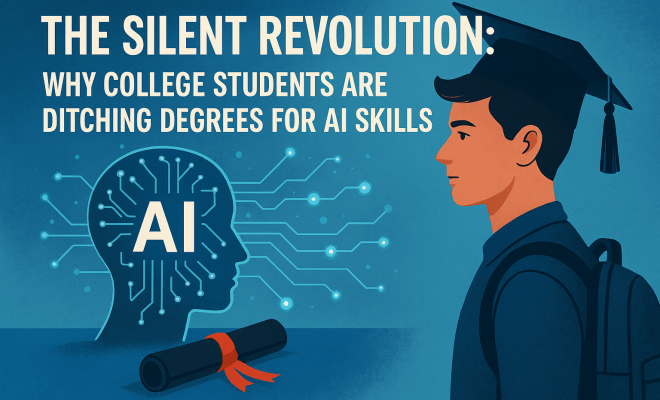
We’re living through a fascinating, somewhat unsettling, transformation in education and the job market. It’s a shift so profound that it’s forcing a reevaluation of what a ‘valuable’ education truly means. Here’s the thing: while colleges are still largely operating on a four-year degree model, the world outside their ivy-covered walls is sprinting ahead, particularly in the realm of artificial intelligence. What we’re seeing now is a quiet, yet powerful, revolution led by college students themselves. They’re not waiting for their institutions to catch up. Instead, they’re taking matters into their own hands, grabbing a degree in one hand and an AI certification in the other.
This isn’t just about adding a line to a resume; it’s about survival and relevance in a rapidly changing economy. Students are increasingly turning to online learning platforms like Coursera and Simplilearn, not as a supplement, but as a critical pathway to acquire the vital AI skills employers are desperately seeking. My experience, from years as a K-12 teacher to heading departments at universities and running my own education consulting group, has shown me firsthand how slowly traditional education often moves. But the pace of AI development? That’s not slow; it’s warp speed. And our students, bless their proactive hearts, are feeling that pressure acutely. They understand that a traditional degree alone might not be enough to secure a meaningful career in an AI-first world.
The Growing Chasm Between Academia and Industry Needs
For decades, a college degree was the golden ticket. You’d spend four years, specialize in a field, and emerge ready for a career. While that pathway still exists, its efficacy is being challenged daily by the relentless march of technological innovation. The curriculum development cycle in higher education is notoriously slow. Think about it: proposing a new course, getting it approved through various committees, designing the content, training faculty – it can take years. Meanwhile, AI capabilities, tools, and applications are evolving not annually, but monthly, sometimes weekly.
This creates a significant chasm. On one side, you have universities, often steeped in tradition, struggling to update their offerings quickly enough. On the other, you have industries, particularly tech and increasingly every other sector, clamoring for talent with very specific, cutting-edge AI competencies. Employers aren’t just looking for theoretical knowledge; they want individuals who can immediately apply machine learning algorithms, understand data pipelines, or develop AI-powered solutions. This isn’t a critique of higher education’s fundamental value – critical thinking, broad knowledge, and analytical skills remain crucial – but it is an undeniable observation about its speed and agility in a dynamic marketplace.
The result? Students are left in a precarious position. They’re investing significant time and money into degrees that, while foundational, might not equip them with the practical, in-demand skills needed for entry-level positions. This realization is a powerful motivator, pushing them to seek alternative, faster, and more focused educational pathways that directly address industry needs. It’s a pragmatic response to a perceived deficit, and it’s reshaping the landscape of professional development even before students graduate.
Why AI Courses for College Students are Exploding in Popularity
The surge in enrollment for upskilling programs offered by Edtech companies isn’t just a blip; it’s a clear trend. Data from platforms like Coursera, for instance, shows a dramatic increase in college students enrolling in specialized AI and data science courses. Why? Because these platforms offer several advantages that traditional institutions often can’t match. They’re agile, constantly updating their course material to reflect the latest industry standards and tools. They’re often taught by industry experts, people who are actively working with AI rather than just teaching about it from a textbook written years ago.
Moreover, these AI courses for college students are typically structured as certifications or specializations, meaning they are focused, project-based, and designed for rapid skill acquisition. A student can complete a specialization in Python for Data Science, Machine Learning Engineering, or Deep Learning in a matter of months, not years. This focused approach means they gain immediately applicable skills that can be showcased on a portfolio or during an interview. It’s a direct response to the employer demand for demonstrable skills, not just a degree certificate. Students are effectively building a parallel, supplementary credentialing system that fills the gaps left by their formal education.
Think of it this way: a computer science degree provides the foundational theory, the algorithms, the computational thinking. But an AI certification from a platform like Google AI or IBM AI Professional Certificate, often hosted on Coursera, gives you the practical experience with TensorFlow, PyTorch, or cloud-based AI services. It’s the difference between understanding how an engine works and knowing how to tune it for optimal performance. Both are important, but one directly translates to immediate job readiness in today’s market.
The Rise of Edtech as a Career Catalyst
Edtech companies have stepped into this void with remarkable efficiency. Platforms such as Coursera, Simplilearn, edX, and Udacity have become indispensable resources for students looking to bridge the skill gap. They offer a vast array of AI courses for college students, ranging from introductory concepts to highly specialized topics like natural language processing, computer vision, and generative AI. These platforms aren’t just providing content; they’re offering structured educational pathways, often culminating in industry-recognized certifications. (See: AI education and career trends.)
What makes them particularly attractive is their flexibility. Students can learn at their own pace, fitting coursework around their traditional degree schedules. This asynchronous learning model is a huge boon for busy college students who are already juggling classes, part-time jobs, and extracurriculars. Furthermore, the cost, while not negligible, is often significantly lower than traditional university tuition for comparable specialized training, making these certifications a more accessible option for many.
The impact is profound: Edtech isn’t just supplementing education; it’s actively shaping career trajectories. Students are emerging from their undergraduate programs with a double advantage: a foundational degree and a portfolio of practical AI skills validated by industry-aligned certifications. This dual approach is quickly becoming the new standard for career readiness, especially in tech-forward fields, and it’s a testament to the agility and responsiveness of the Edtech sector. For more context, see Why Ignoring AI Training Now Could Brutally End Your Career.
The Alarming Decline in Entry-Level AI Roles
Here’s where the emotional charge and urgency really come into play. Recent studies are painting a somewhat stark picture for new graduates. While AI adoption is undeniably boosting overall hiring and creating new types of jobs, it’s also disproportionately favoring senior, more experienced roles. This means a concerning decline in junior and entry-level positions. Think about it: if an AI tool can automate rote tasks that were once assigned to a junior analyst, companies will deploy the AI. This isn’t about replacing all jobs, but it is about redefining what ‘entry-level’ means.
For college students, this data is incredibly sobering. They’re entering a job market where the traditional stepping stones might be eroding. The expectation that one can graduate with a general degree and ‘learn on the job’ for many technical roles is becoming a risky gamble. Employers, facing intense competition and pressure to innovate, want talent that can hit the ground running, especially with AI. They’re less willing to invest in extensive training for basic AI competency when they can hire someone who already possesses those skills, or when an AI can perform those tasks.
This reality fuels the ‘degree in one hand, AI course in the other’ phenomenon. Students aren’t just being proactive; they’re reacting to a perceived threat to their career prospects. They see the writing on the wall: without specialized AI skills, their chances of securing those increasingly scarce entry-level roles diminish significantly. It’s a race to acquire the skills that make them indispensable, even at the very start of their professional journey.
The New Blueprint for Career Readiness: Blending Traditional and Modern Learning
So, what’s the optimal strategy for today’s college student? It’s clear that a blended approach is emerging as the most robust pathway to career readiness. The traditional four-year degree still offers immense value: it cultivates critical thinking, communication skills, a broad understanding of various disciplines, and networking opportunities. These are foundational elements that AI, as powerful as it is, cannot replicate.
However, simply relying on that degree is no longer sufficient. The modern student needs to actively integrate specialized, practical AI training into their educational journey. This means consciously seeking out AI courses for college students offered by Edtech platforms, participating in AI-focused hackathons, contributing to open-source AI projects, and even pursuing internships that heavily involve AI technologies. It’s about creating a personal curriculum that combines the depth and breadth of a university education with the agility and specificity of industry-aligned skill development.
For instance, a liberal arts major might complement their humanities degree with a certification in AI ethics or data storytelling. A business student could pursue a specialization in AI for marketing or supply chain optimization. A computer science major would naturally deepen their expertise with advanced machine learning or deep learning certifications. This isn’t about choosing one path over the other; it’s about intelligently combining them to create a unique and highly marketable profile.
The Role of Universities in a Rapidly Evolving AI Landscape
This trend presents a critical challenge and an immense opportunity for universities. They can either resist this shift, clinging to outdated models, or they can embrace it, becoming more responsive and integrated with industry needs. Frankly, as someone who’s spent years in higher education, I’d strongly advocate for the latter. Universities need to accelerate their curriculum development processes, perhaps by partnering more directly with industry leaders to co-create relevant modules or even full programs. Imagine if universities offered official academic credit for completing certain high-quality AI certifications from platforms like Coursera – that would be a game-changer.
They also need to better integrate AI across disciplines, not just in computer science departments. Every student, regardless of their major, will interact with AI in their future careers. Therefore, basic AI literacy, understanding its capabilities, limitations, and ethical implications, should become a core component of general education. This doesn’t mean every student needs to become an AI engineer, but they do need to be informed users and critical thinkers about AI’s societal impact.
Furthermore, universities should leverage their research capabilities to not just study AI, but to actively contribute to its responsible development and application. By doing so, they can position themselves as thought leaders and incubators of cutting-edge AI talent, attracting students who are eager to be at the forefront of this technological revolution. The goal isn’t to become an Edtech platform, but to evolve into an institution that prepares students for the *real* future, not just the past. (See: impact of AI on education.)
Practical Steps for College Students to Embrace AI Upskilling
If you’re a college student reading this, feeling that familiar mix of excitement and anxiety about your future, here are some concrete steps you can take to proactively build your AI skill set:
- Identify Your Niche: Don’t just jump into any AI course. Think about your major and your career aspirations. Do you want to work in healthcare? Look for AI in medicine courses. Interested in finance? Explore AI for financial modeling. Targeting a specific industry will help you choose relevant AI courses for college students.
- Start with Fundamentals: Before diving into deep learning, ensure you have a solid grasp of Python programming, basic statistics, and data structures. Many Edtech platforms offer excellent introductory courses in these areas.
- Leverage Major Platforms: Explore offerings from Coursera (which hosts specializations from top universities and companies like Google, IBM, and DeepLearning.AI), Simplilearn, edX, and Udacity. Look for professional certificates or guided projects.
- Build a Portfolio: Don’t just complete courses; apply what you learn. Work on small personal projects, participate in Kaggle competitions, or contribute to open-source AI initiatives. A demonstrable portfolio of AI projects is far more impactful than just a certificate.
- Network Actively: Join AI communities, attend virtual meetups, and connect with professionals on LinkedIn. Learning from others and understanding industry trends is invaluable.
- Stay Current: AI is moving fast. Subscribe to AI newsletters, follow prominent AI researchers and practitioners on social media, and read industry publications regularly.
- Consider Internships with an AI Focus: Seek out internships where you can apply your nascent AI skills. Practical experience is gold, especially when paired with formal training.
Remember, this isn’t about abandoning your degree; it’s about enhancing it, making it more potent and relevant for the world you’re about to enter. It’s about taking agency over your own career development. For more context, see Why AI Upskilling Is Your Only Path to Job Security.
The Monetization Potential and Future of AI Education
From an entrepreneurial perspective, the explosion of interest in AI skills, particularly among college students, represents a massive monetization opportunity. For Edtech companies, this is a golden age. They can offer high-quality, in-demand AI courses for college students and professionals, often at a premium, because the career returns on these skills are so significant. We’re already seeing this with platforms offering AI certifications that can cost hundreds or even thousands of dollars, but which promise a tangible return on investment through better job prospects and higher salaries.
For content creators and educators like myself, this trend highlights the demand for well-researched, practical guidance on navigating the AI landscape. This article, for instance, serves not just to inform but also to connect readers with potential solutions – think affiliate links to specific AI certification programs or resources on Edtech platforms. The online education and software/B2B SaaS niches are particularly ripe for this, as they cater directly to individuals and businesses seeking career advancement and skill acquisition in AI.
Looking ahead, I anticipate a continued blurring of lines between traditional degrees and specialized certifications. We might see micro-credentials gaining even more traction, with employers valuing a stack of specific skills over a single, broad degree. Universities that adapt quickly, perhaps by integrating Edtech offerings into their own curricula or even developing their own agile AI programs, will thrive. Those that don’t risk becoming increasingly marginalized in the eyes of career-focused students. The future of education isn’t just about what you learn, but how quickly and relevantly you can learn it.
A New Era of Student Empowerment
Ultimately, what we’re witnessing is a profound shift in student empowerment. No longer are students passively waiting for institutions to dictate their learning path. They are actively curating their own education, combining the best of traditional academic rigor with the speed and specificity of online AI courses for college students. This independent drive is a powerful force, signaling a future where learning is continuous, personalized, and directly aligned with the demands of an ever-evolving job market.
It’s a testament to the resilience and foresight of today’s youth. They understand that a piece of paper, no matter how prestigious, is only one part of the equation. The real currency in the AI era is demonstrable skill and the ability to adapt. As an educator and entrepreneur in this space, I find this trend incredibly exciting. It pushes all of us – universities, Edtech providers, and even individual learners – to be more innovative, more responsive, and more committed to genuine career readiness. The students are leading the way, and it’s up to the rest of us to keep pace.
The Impact of Generative AI on Entry-Level Roles
Let’s zoom in on something specific that’s shaking up the job market: generative AI. Tools like ChatGPT, Midjourney, and GitHub Copilot aren’t just fascinating curiosities; they’re fundamentally altering how work gets done, especially at the entry-level. Historically, many junior roles involved tasks that were repetitive, data-entry heavy, or required basic content creation. Now, a significant chunk of these tasks can be automated or significantly augmented by generative AI. This isn’t just a hypothetical; we’re seeing it play out in real-time.
For example, a junior marketing associate might have spent hours drafting initial social media posts or email copy. Now, generative AI can produce multiple drafts in minutes, leaving the human to refine, strategize, and personalize. Similarly, a junior programmer might have handled boilerplate code or bug fixes; Copilot can now suggest and even write much of that. This isn’t to say these roles disappear entirely, but their nature changes dramatically. The entry-level employee of today needs to be proficient in *using* these AI tools, not just performing the tasks they automate. They need to understand how to prompt effectively, critically evaluate AI outputs, and integrate AI into workflows. This directly underscores why AI courses for college students are no longer a ‘nice-to-have’ but a ‘must-have’ for securing those first career steps. For more context, see The Staggering Truth About AI in Higher Ed: Why Students Are Panicking. (See: students adapting to AI skills.)
Bridging the Gap: University-Industry Partnerships for AI Education
The idea of universities partnering with industry isn’t new, but for AI education, it’s becoming absolutely essential. We’re talking about more than just guest speakers or career fairs. True partnerships mean companies like Google, Microsoft, or IBM actively collaborating with universities on curriculum design, providing real-world datasets for student projects, or even embedding their engineers as adjunct faculty. This kind of deep integration ensures that the AI courses for college students taught within academic walls are genuinely aligned with current industry practices and future needs.
Imagine a university program where students work on a semester-long project sponsored by a tech company, using their actual data and tools, with mentorship from industry professionals. That’s the kind of experiential learning that truly prepares students for the AI-driven workplace. These partnerships can also facilitate more seamless internship-to-hire pipelines, giving students a direct path into companies that desperately need AI talent. It’s a win-win: universities get to offer cutting-edge, relevant education, and companies get a pipeline of job-ready graduates. We need to push for more of these symbiotic relationships, moving beyond mere academic theory to practical, hands-on, industry-informed AI training.
FAQ: Navigating AI Courses for College Students
Q1: I’m not a computer science major. Are AI courses still relevant for me?
Absolutely! AI isn’t just for coders anymore. It’s impacting every field. If you’re a business student, AI for marketing or supply chain optimization is crucial. A humanities major might explore AI ethics or natural language processing for text analysis. Healthcare students can look into AI in diagnostics or personalized medicine. Understanding AI’s capabilities and limitations will be a valuable asset in any career path.
Q2: How do I choose the right AI course or certification given so many options?
Start by identifying your interests and career goals. Do you want to work with data, build models, or understand the ethical implications? Look for courses that align with those interests. Read reviews, check the instructors’ backgrounds (industry experience is a big plus), and see if the course offers hands-on projects or a recognized certification. Platforms like Coursera often have ‘Specializations’ or ‘Professional Certificates’ that bundle several courses together, providing a structured learning path.
Q3: Will an AI certification replace my college degree?
No, not entirely. Think of an AI certification as a powerful enhancement to your degree, not a replacement. Your college degree provides foundational knowledge, critical thinking skills, and a broader educational context that certifications don’t. The blended approach – a degree plus specialized AI skills – is what employers are increasingly looking for. It shows you have both depth of understanding and practical, in-demand abilities.
Q4: How much time should I dedicate to AI upskilling alongside my degree?
This depends on your schedule and the intensity of the AI courses you choose. Many online courses are designed to be flexible, allowing you to learn at your own pace. Even dedicating a few hours a week can make a significant difference over time. Look for micro-credentials or short courses that you can complete within a semester or during breaks. Consistency is key, even if it’s just a little bit at a time.
Trending Now
Frequently Asked Questions
Why are college students pursuing AI skills instead of degrees?
College students are increasingly pursuing AI skills over traditional degrees due to the rapid evolution of the job market. With employers seeking practical AI expertise, students are turning to online platforms for certifications that enhance their employability, recognizing that a degree alone may not guarantee career success in an AI-driven economy.
What are the benefits of online learning for students?
Online learning offers flexibility, accessibility, and the ability to acquire specific skills quickly. Platforms like Coursera and Simplilearn allow students to learn at their own pace, focusing on in-demand skills like AI, which are crucial for staying relevant in today's job market.
How is the traditional education system failing students?
The traditional education system is often slow to adapt to industry needs, with lengthy processes for curriculum changes. This lag leaves students unprepared for the fast-paced job market, prompting them to seek alternative learning paths that provide immediate, relevant skills.
What role does AI play in the current job market?
AI is transforming the job market by creating new opportunities and changing the skills employers value. As industries increasingly rely on AI technologies, the demand for workers with AI competencies is soaring, leading students to prioritize these skills over conventional degree paths.
Are AI certifications worth it for college students?
Yes, AI certifications are highly valuable for college students as they demonstrate practical skills sought by employers. These credentials can enhance a resume, provide a competitive edge in the job market, and help students secure meaningful careers in an increasingly AI-focused economy.
What's your take on this? Share your thoughts in the comments below — we read every one.