Baffling: Why Laid-Off Academics Are Finding New Hope in These Reskilling Programs
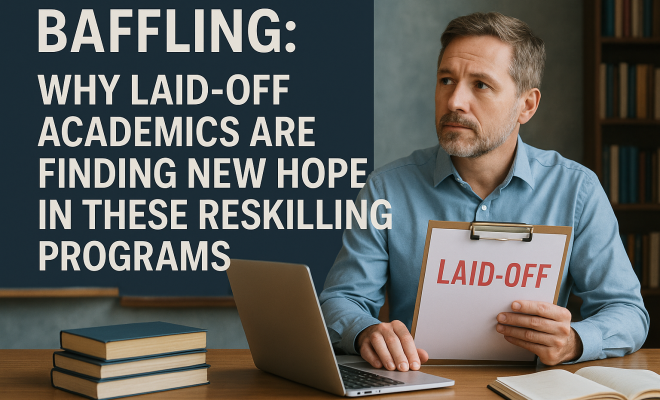
The landscape of higher education is shifting beneath our feet, and for many dedicated academics, it’s been a seismic, heartbreaking experience. Just look at Bowie State University, a historically Black institution in Maryland. They announced plans on October 2, 2026, to lay off 20 faculty members, following a staggering 79 staff cuts earlier in the spring. These aren’t just numbers; they’re careers, livelihoods, and passions abruptly ended. Bowie State is grappling with an $18 million deficit for fiscal year 2027, a financial quagmire projected to persist into 2028. What makes this particularly poignant, even baffling, is that these cuts are happening despite the university receiving substantial unrestricted donations totaling $75 million from philanthropist MacKenzie Scott in 2020 and 2025. It’s a stark reminder that even philanthropic generosity can’t always outrun systemic financial pressures.
This isn’t an isolated incident, either. The situation at Bowie State is a microcosm of a broader, emotionally charged crisis unfolding across U.S. higher education. Thousands of faculty and staff positions have been eliminated across institutions in 2025 and 2026. The culprits? Declining enrollments, relentless federal funding pressures, and escalating operational costs. It’s a perfect storm that’s left many brilliant minds, who dedicated their lives to teaching and research, suddenly adrift. For these laid-off academics, the immediate future can feel daunting, but it’s far from hopeless. The good news is that there are excellent pathways to pivot, to reskill, and to find new, fulfilling career opportunities. In fact, some of the best reskilling programs for laid-off academics are online, offering the flexibility and industry relevance needed to navigate this challenging transition.
1. Google Career Certificates: Bridging the Digital Divide
When we talk about the best reskilling programs for laid-off academics, Google Career Certificates inevitably come up, and for good reason. Google has invested heavily in these programs, recognizing a significant skills gap in the modern workforce. These certificates cover high-demand fields like IT Support, Data Analytics, Project Management, UX Design, and Digital Marketing. What makes them particularly attractive for former academics is their practical, hands-on approach. They’re designed by Google experts, meaning the curriculum is directly relevant to what employers are actually looking for in today’s tech-driven landscape.
The flexibility is another huge draw. These are entirely online and self-paced, allowing individuals to learn around existing commitments or while actively job searching. Many laid-off academics might worry about the cost of further education, but these certificates are surprisingly affordable, especially when you consider the potential return on investment. Scholarships are also available through various partners, which can further alleviate financial burdens. For an academic whose expertise might have been in a humanities field, for example, transitioning into data analytics or project management offers a robust career path with significant growth potential, leveraging their inherent research, organizational, and critical thinking skills.
2. Coursera Professional Certificates: University-Quality Learning, Industry-Focused Outcomes
Coursera has become a powerhouse in online learning, and their Professional Certificates are particularly well-suited for academics looking to reskill. What sets Coursera apart is its partnerships with top universities and leading companies. This means you’re not just getting a generic online course; you’re often getting content developed by institutions like Yale, Stanford, or Google itself. For an academic, this institutional pedigree can be reassuring, marrying the rigor they’re accustomed to with practical, career-oriented skills.
These certificates often span fields like AI, cybersecurity, cloud computing, and various business specializations. Imagine a professor of literature transitioning into a role as a content strategist or a technical writer for a tech firm, or a historian moving into data curation and analysis for a digital archive. Coursera’s structured learning paths, often culminating in projects or portfolios, provide tangible evidence of new skills to prospective employers. Many of these programs also offer career support resources, helping participants translate their academic backgrounds into marketable industry skills and connect with hiring partners. It’s a comprehensive approach to professional development that acknowledges the unique needs of a transitioning professional.
3. edX MicroBachelors and MicroMasters Programs: A Stepping Stone to New Credentials
edX, another giant in the MOOC (Massive Open Online Course) space, offers something truly unique for laid-off academics: MicroBachelors and MicroMasters programs. These aren’t just certificate programs; they’re pathways to actual university credit, recognized by partner institutions. This is a game-changer for someone who might feel their existing academic credentials aren’t directly translating to new industries. A MicroBachelors program, for instance, can provide a solid foundation in a new field, with some credits potentially counting towards a full bachelor’s degree if one chooses to pursue it.
Similarly, MicroMasters programs are designed to be standalone credentials that can also count towards a full Master’s degree. This means an academic with a Ph.D. in, say, philosophy, could complete a MicroMasters in supply chain management or data science, gaining a specialized, university-backed credential that significantly boosts their employability in a new sector. The courses are developed by top universities globally, ensuring academic rigor alongside practical application. For those who value the structure and depth of university-level education but need it delivered in a flexible, modular format, edX offers some of the best reskilling programs for laid-off academics.
4. LinkedIn Learning: A Treasure Trove of Niche Skills
While often seen as a platform for general professional development, LinkedIn Learning deserves a special mention for its vast library of courses that can help laid-off academics acquire highly specific, in-demand skills. Unlike the more structured, certificate-based programs, LinkedIn Learning offers a more à la carte approach. This can be incredibly valuable for someone who knows the general direction they want to go but needs to fill particular skill gaps quickly and efficiently.
For example, an academic looking to transition into instructional design might find excellent courses on specific learning management systems (LMS), adult learning theories, or multimedia content creation. A former researcher might leverage courses on advanced Excel, SQL, or specific data visualization tools. The platform also integrates seamlessly with LinkedIn profiles, allowing learners to easily display new skills and completed courses to potential employers. While it might not offer the same formal credential as a Google or Coursera certificate, its affordability (often included with a LinkedIn Premium subscription) and breadth of content make it an invaluable resource for targeted skill acquisition and continuous professional development.
5. Udemy for Business: Tailored Learning for Organizational Roles
Udemy, much like LinkedIn Learning, offers a massive catalog of courses. However, Udemy for Business (now Udemy Business) is particularly interesting because it’s often utilized by companies to upskill their employees. This means the content is frequently geared towards practical, organizational needs, making it highly relevant for academics looking to transition into corporate or non-profit roles. While individuals can purchase courses directly, many organizations provide access to Udemy Business as an employee benefit. (See: CDC Youth Risk Behavior Survey.)
For academics, this platform can be a goldmine for learning about business processes, project management methodologies (like Agile or Scrum), software development tools, or even leadership and communication skills tailored for the corporate environment. The courses are taught by industry experts, offering real-world insights that might differ from traditional academic approaches. Acquiring skills that are directly applicable to organizational structures can significantly boost a laid-off academic’s appeal to employers outside of higher education, making it one of the practical reskilling programs for laid-off academics who are aiming for industry roles.
6. DataCamp: Mastering the Language of Data
In an age where data is often called the new oil, proficiency in data science, analytics, and programming is an invaluable asset. For laid-off academics with strong analytical minds – and let’s be honest, most academics fit this description – DataCamp offers an incredibly focused and effective pathway to a career in data. This platform specializes exclusively in data science education, offering interactive courses, coding challenges, and projects in languages like Python, R, and SQL, along with various data visualization and machine learning concepts. For more context, see The Staggering Truth About AI in Higher Ed.
The beauty of DataCamp is its hands-on nature. You’re not just watching lectures; you’re actively coding and applying concepts from day one. This immersive approach is excellent for building practical skills and a portfolio of projects that demonstrate competence to potential employers. Many academics, particularly those in STEM fields or social sciences, already possess a foundational understanding of statistics and research methodologies. DataCamp allows them to translate those theoretical skills into the specific technical proficiencies that are in high demand across virtually every industry, from finance to healthcare to marketing. It’s one of the best reskilling programs for laid-off academics who are ready to dive deep into the world of data.
7. General Assembly: Immersive Bootcamps for Rapid Career Change
For those who are ready for an intensive, accelerated shift, General Assembly offers immersive bootcamps in fields like software engineering, data science, UX design, and digital marketing. Unlike the self-paced options, these are typically full-time, several-month-long programs designed to get participants job-ready in a compressed timeframe. While they represent a significant time and financial commitment, their career outcomes can be impressive.
What makes General Assembly particularly effective for laid-off academics is their strong emphasis on career services. They often have dedicated career coaches, employer networks, and interview preparation built into their programs. This comprehensive support system is crucial for individuals making a significant career pivot, helping them not only acquire new skills but also navigate the job market in a completely different sector. These bootcamps are for the bold, the motivated, and those who thrive in a fast-paced, project-based learning environment, offering a direct route to some of the most sought-after tech jobs.
8. Professional Associations and Industry Certifications: Niche Expertise and Networking
Beyond the major online learning platforms, many professional associations offer highly specialized certifications and training programs that can be incredibly valuable for laid-off academics. Think about fields like project management (Project Management Institute – PMI), human resources (Society for Human Resource Management – SHRM), or even specific software certifications (like Salesforce Administrator or HubSpot certifications). These certifications often validate a very specific set of skills that are directly applicable to particular industry roles.
The advantage here is two-fold: not only do you gain a recognized credential, but you also gain access to a professional network within that specific industry. For an academic who might feel disconnected from corporate or non-profit sectors, joining these associations and pursuing their certifications can open doors to mentorship, job leads, and a deeper understanding of industry best practices. It’s a strategic move for those who have identified a niche area they wish to enter and want to quickly establish credibility. These programs might not always be ‘online’ in the sense of a full course, but many offer online study materials, exams, and virtual networking opportunities, making them highly accessible and among the most targeted reskilling programs for laid-off academics.
The Transferable Skills Advantage: Why Academics Excel at Reskilling
It’s easy for a laid-off academic to feel like their years of specialized study and research are suddenly irrelevant. But that’s just not true. Academics possess a wealth of highly transferable skills that are incredibly valuable in diverse industries. Think about it: years spent researching, analyzing complex data, writing extensively, presenting findings, managing projects (like dissertations or grant applications), and teaching diverse groups of students. These aren’t just academic exercises; they’re foundational professional competencies.
For example, a historian’s ability to synthesize vast amounts of information, identify patterns, and construct compelling narratives is directly applicable to roles in content strategy, market research, or even technical writing. A philosophy professor’s rigorous critical thinking and logical reasoning skills are prized in fields like data analytics, cybersecurity, or policy analysis. Scientists, of course, bring a strong background in experimental design, statistical analysis, and problem-solving. Even the soft skills cultivated in academia—like public speaking, mentorship, collaboration, and adapting to new information—are highly sought after. The trick isn’t to abandon your academic past, but to articulate how those deeply ingrained skills translate into tangible assets for a new employer. Many of the best reskilling programs for laid-off academics recognize this inherent strength and help participants frame their existing capabilities for new career paths.
Navigating the Emotional Landscape of Career Transition
Beyond the practicalities of choosing a reskilling program, it’s crucial to acknowledge the profound emotional impact of being laid off, especially from a career that’s often seen as a calling. Academia can be deeply intertwined with personal identity, and losing that can feel like a loss of self. There’s grief, anger, frustration, and often a sense of uncertainty about the future. It’s important to give yourself space to process these feelings.
Connecting with others who are going through similar transitions can be incredibly helpful. Online communities, professional networking groups, or even informal meet-ups can provide a sense of solidarity and shared experience. Many universities also offer outplacement services or career counseling for a period after layoffs, which can provide not just practical job search assistance but also emotional support. Remember, this isn’t a reflection of your worth or capabilities. It’s a systemic shift that’s affecting many talented individuals. Focusing on self-care, maintaining a routine, and celebrating small victories in your reskilling journey can make a significant difference in maintaining a positive outlook during this challenging time.
Emerging Industries and Niche Opportunities for Reskilled Academics
While tech and data science are prominent pathways, laid-off academics should also consider a broader spectrum of emerging industries and niche roles where their unique blend of skills can truly shine. For instance, the growing field of “knowledge management” is perfect for academics accustomed to organizing, cataloging, and disseminating information. Companies increasingly need experts to manage internal knowledge bases, train staff on best practices, and ensure efficient information flow.
Another area is “learning and development” (L&D) within corporations. Former professors often make excellent instructional designers, corporate trainers, or L&D specialists because they understand pedagogy, curriculum development, and adult learning principles. The boom in online education isn’t limited to traditional universities; many companies are building sophisticated internal training platforms and need skilled educators to design and deliver content. (See: New York Times on college layoffs.)
Consider also the burgeoning “ethical AI” or “AI governance” space. Academics with backgrounds in philosophy, ethics, law, or even social sciences are uniquely positioned to contribute to the responsible development and deployment of artificial intelligence, ensuring it aligns with human values and societal norms. These are roles that require critical thinking, interdisciplinary understanding, and an ability to grapple with complex, abstract problems – all hallmarks of academic training. Exploring these less obvious but rapidly growing sectors can uncover truly fulfilling career paths for reskilled academics.
Funding Your Reskilling Journey: Grants, Scholarships, and Creative Solutions
The financial aspect of reskilling can be a major hurdle. Many laid-off academics might already be facing financial strain, and the idea of investing in new training can feel overwhelming. However, there are numerous avenues to explore for financial assistance. For more context, see The Startling Truth About AI: Why Higher Ed Faculty Are Falling Behind.
First, many of the programs mentioned, like Google Career Certificates and Coursera, offer scholarships directly or through partner organizations. It’s always worth checking their websites for financial aid options. Second, explore government programs. In the U.S., the Workforce Innovation and Opportunity Act (WIOA) provides funding for job training and employment services to eligible individuals, which can include reskilling programs. State workforce development agencies are excellent resources for this. Additionally, some professional associations offer grants or scholarships for individuals pursuing certifications in their field.
Don’t overlook university alumni networks either. Some universities have funds specifically for alumni in career transition or can offer discounted access to their extension programs. Lastly, consider creative budgeting. Many online courses are significantly more affordable than traditional degrees. Prioritize programs that offer the highest return on investment in terms of job placement and salary potential. Sometimes, a smaller, targeted investment can yield significant career dividends, especially when combined with your existing academic strengths.
The Role of Mentorship and Networking in a Successful Pivot
Reskilling isn’t just about acquiring new technical skills; it’s also about building a new professional identity and network. For academics accustomed to a relatively defined career path, venturing into new industries can feel like starting from scratch. This is where mentorship and networking become absolutely critical.
Seek out mentors who have successfully transitioned from academia to industry, or who are established in the field you’re targeting. They can offer invaluable advice, share insights into industry culture, and help you understand how to best leverage your academic background. LinkedIn is an excellent tool for identifying and connecting with potential mentors. Don’t be afraid to send polite, personalized messages explaining your situation and asking for an informational interview.
Networking isn’t just about finding a job; it’s about learning. Attend industry webinars, virtual conferences, and local meetups (if safe and available). Engage with professionals on platforms like LinkedIn and Pedagogue. The goal is to understand the language, challenges, and opportunities of your target industry. Every conversation is a chance to learn something new, refine your career narrative, and potentially uncover a lead that an online job board would never reveal. Remember, your academic background has prepared you to be a lifelong learner and a skilled communicator – these are your biggest assets in building a new network.
The Imperative of Personal Branding and Resume Reframing
Once you’ve acquired new skills, the next crucial step is to effectively communicate your new capabilities to potential employers. This means a complete overhaul of your resume, LinkedIn profile, and overall personal brand. The language of academia is very different from the language of industry, and a direct translation simply won’t work.
Your resume needs to be results-oriented and skill-focused, not a chronological list of publications and teaching appointments. Translate your academic achievements into quantifiable outcomes. For example, instead of “Taught undergraduate courses in X and Y,” you might write, “Designed and delivered curriculum to 150+ students annually, resulting in a 90% course completion rate and measurable improvements in critical thinking skills.” Highlight projects from your reskilling programs and emphasize the practical tools and methodologies you’ve mastered. Similarly, your LinkedIn profile should reflect your new career aspirations, featuring relevant keywords and endorsements for your new skills.
Personal branding extends to how you present yourself in interviews. Be ready to articulate your “why” – why you’re transitioning, what motivates you about the new field, and how your unique academic background brings a fresh perspective. Practice framing your academic experiences in a way that demonstrates transferable skills like problem-solving, project management, communication, and analytical thinking. This strategic reframing is just as important as the reskilling itself in opening new doors. For more context, see 9 Financial Strategies Every Educator Needs Now to Survive Job Uncertainty.
FAQ: Reskilling for Laid-Off Academics
Q1: I have a Ph.D. in a niche humanities field. Can I really reskill for a tech job?
Absolutely! Your humanities Ph.D. has equipped you with incredible critical thinking, research, analytical, and communication skills. These are highly valued in tech roles like UX research, technical writing, content strategy, data analysis (especially for qualitative data), and even project management. Programs like Google Career Certificates or Coursera’s Professional Certificates are designed to bridge the gap by providing the technical skills, while your existing academic strengths give you a unique edge.
Q2: How long does it typically take to complete one of these reskilling programs?
The timeframe varies significantly. Google Career Certificates can often be completed in 3-6 months if you dedicate 10-15 hours per week. Coursera and edX Professional/MicroMasters programs might take 6 months to a year, depending on the program’s intensity and your pace. Immersive bootcamps like General Assembly are usually 3-6 months of full-time study. Self-paced platforms like LinkedIn Learning or Udemy are entirely up to you. The key is consistency.
Q3: Are these online certificates truly recognized by employers?
Yes, increasingly so! Especially certificates from reputable providers like Google, Coursera (partnered with universities), and edX. Employers recognize the practical, industry-aligned skills these programs teach. It’s not about replacing a degree but complementing it with in-demand competencies. The value comes from the demonstrable skills you acquire and the projects you can showcase, rather than just the certificate itself.
Q4: What if I don’t want to go into tech? Are there other options?
Definitely. While tech roles are prominent, your transferable skills are valuable in many sectors. Consider instructional design for corporate learning and development, non-profit program management, grant writing, research roles in market intelligence or policy, technical editing, content creation, or even consulting. Professional associations (like PMI for project management or SHRM for HR) offer certifications relevant to a wide range of industries beyond pure tech.
Q5: How do I address the career gap or career change in interviews?
Be proactive and frame it positively. Emphasize your resilience, adaptability, and commitment to lifelong learning. Explain that the shifts in higher education prompted you to leverage your intellectual curiosity and analytical skills in a new context. Focus on what you’ve gained through your reskilling efforts and how your unique academic background brings a valuable, fresh perspective to the role and company. Practice your “transition narrative” until it feels natural and confident.
Q6: Should I pursue another degree (Master’s or even a second Ph.D.)?
For most laid-off academics looking to pivot quickly, another traditional degree is usually not the most efficient path. It’s often time-consuming, expensive, and might not directly address the specific skills gaps for industry roles. Reskilling programs, certificates, and bootcamps are designed for rapid skill acquisition and career transition. A MicroMasters from edX might be an exception if it directly aligns with your new career goal and offers university credit, but for immediate job readiness, shorter, focused programs are generally better.
Q7: How important is networking when reskilling?
Extremely important. Networking can open doors that job boards won’t, provide critical industry insights, and help you refine your career goals. It also helps combat the isolation that can come with career transition. Connect with people on LinkedIn, attend virtual industry events, and seek out informational interviews. Many jobs are found through connections, not just applications.
The reality is, the challenges facing higher education are complex and deeply unsettling for many who’ve dedicated their lives to it. The cuts at institutions like Bowie State are a stark reminder of the financial pressures at play, even with significant philanthropic backing. But for those affected, the path forward doesn’t have to be one of despair. There’s a vibrant ecosystem of online reskilling programs designed to equip former academics with the tools, skills, and confidence to thrive in new, exciting fields. Whether it’s diving into data science with DataCamp, mastering project management through Coursera, or leveraging the vast resources of LinkedIn Learning, the opportunities to pivot and build a new, fulfilling career are more accessible than ever before. The key is to embrace the change, identify transferable skills, and commit to continuous learning, because the intellectual curiosity that made you an academic is precisely what will make you successful in your next chapter.
Trending Now
Frequently Asked Questions
What are the reasons behind layoffs in higher education?
Layoffs in higher education are primarily driven by declining enrollments, persistent federal funding pressures, and rising operational costs. Institutions like Bowie State University are facing significant financial deficits, leading to difficult decisions about faculty and staff positions.
How are laid-off academics finding new opportunities?
Laid-off academics are discovering new opportunities through reskilling programs that offer relevant skills for today’s job market. Many of these programs are available online, providing flexibility and the chance to pivot into new, fulfilling careers.
What are Google Career Certificates?
Google Career Certificates are online programs designed to help individuals gain job-ready skills in high-demand fields such as IT, data analytics, and project management. They are particularly beneficial for laid-off academics looking to transition into new careers.
What should laid-off academics do next?
Laid-off academics should explore reskilling options, such as online courses or certificates, to gain new skills that align with current job market demands. Networking and seeking mentorship can also provide valuable guidance during this transition.
Why are philanthropic donations not preventing layoffs in universities?
Philanthropic donations, like those received by Bowie State University, may not address systemic financial issues such as budget deficits and operational costs. These funds often come with restrictions or may not be sufficient to cover ongoing financial challenges.
What did we miss? Let us know in the comments and join the conversation.