The AI Jobs Reckoning: 9 Ways to Future-Proof Your Career RIGHT NOW
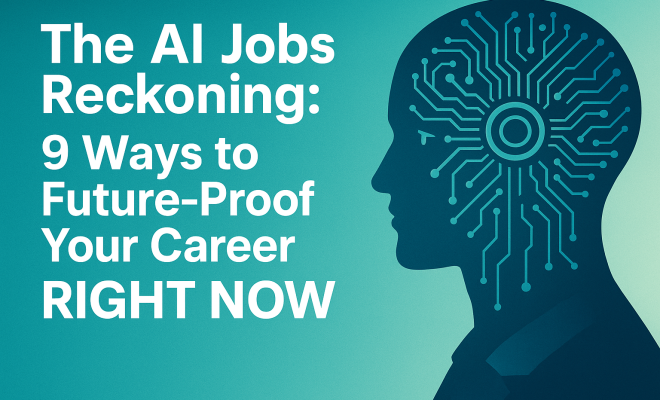
Look, if you’re a recent graduate, or even just thinking about your career path, you’ve probably heard the buzz about AI. But here’s the harsh truth: that buzz isn’t just background noise anymore. It’s a seismic shift, and it’s already hitting the job market hard. A new study from economists at the U.S. Census Bureau paints a pretty stark picture: since ChatGPT burst onto the scene in late 2022, recent college graduates in majors most exposed to AI are facing a job market that feels a lot like a major recession. We’re talking about a 5 percentage point drop in initial employment likelihood and a 13% earnings slip. That’s not a small adjustment; that’s a significant blow, forcing many bright, ambitious grads into lower-paying roles in retail and restaurants, far from their chosen fields. It’s a critical moment for understanding how to future-proof your career against AI displacement.
As someone who’s spent years in education, from K-12 classrooms to university deanships, I’ve seen my share of educational trends come and go. But this isn’t just a trend; it’s a fundamental reordering of the workforce. The good news? You’re not helpless. This isn’t about throwing your hands up in despair. It’s about being proactive, strategic, and smart about how you build your skill set and choose your path. We need to talk about actionable steps, real strategies you can employ today to build a resilient career in an era where technology is evolving at warp speed. Let’s dig into nine essential ways to do just that.
1. Embrace the Human-Centric Skills AI Can’t Replicate: The Empathy Advantage
One of the biggest mistakes you can make right now is trying to out-AI the AI. You won’t win that race. Instead, focus on the unique human attributes that even the most advanced algorithms struggle to replicate. Think about skills like emotional intelligence, critical thinking, complex problem-solving, creativity, and nuanced communication. These aren’t just buzzwords; they are the bedrock of what makes us indispensable in the workplace.
For instance, while AI can generate reams of data analysis, it can’t intuitively understand the emotional context of a client’s complaint or the subtle team dynamics that lead to a breakthrough idea. It can’t truly empathize with a customer’s frustration or inspire a team through a challenging project. These are the domains where human beings will always have the upper hand. Developing these ‘soft skills,’ as they’re often called, isn’t about being ‘nice’; it’s about being strategically invaluable. It’s about honing your ability to connect, persuade, and innovate in ways that go beyond mere information processing.
Let’s break this down a bit more. Emotional intelligence, for example, isn’t just about feeling emotions; it’s about understanding and managing your own emotions, and recognizing and influencing the emotions of others. This is crucial in sales, client relations, HR, and any leadership role. Critical thinking means not just accepting information but evaluating it, questioning assumptions, and forming reasoned judgments. AI can process information, but it doesn’t inherently question its own biases or the biases in its training data. Creativity, too, extends beyond generating variations of existing ideas; it’s about genuine innovation, seeing connections no one else does, and imagining entirely new possibilities. These are the sparks that drive progress, and they are uniquely human.
2. Pivot Towards ‘AI-Proof’ Trade Skills and Hands-On Professions: The Rise of the Craftsman
The alarming trends in traditional college majors are pushing a significant number of Gen Z individuals towards a different path, and frankly, it’s a smart one. Many are increasingly turning to trade schools and vocational training for careers that are inherently less susceptible to AI displacement. Think about it: a plumber, an electrician, a welder, a carpenter, a dental hygienist – these are professions that require physical dexterity, on-site problem-solving, and a human touch that AI simply cannot replicate.
These aren’t ‘lesser’ careers; they are secure, essential, and often well-paying jobs that form the backbone of our infrastructure and daily lives. While AI can design a building, it can’t lay the bricks. While AI can diagnose a fault, it can’t physically fix the wiring. The demand for skilled tradespeople isn’t going anywhere; in fact, as more people chase white-collar jobs, the scarcity of these hands-on professionals often drives up their value. If you’re looking at how to future-proof your career against AI, seriously consider these pathways. They offer a tangible skill set that provides immediate value and long-term stability.
The U.S. Bureau of Labor Statistics consistently projects growth in many skilled trades. For example, electricians are projected to see a 6% growth from 2022 to 2032, adding about 46,900 jobs. Plumbers, pipefitters, and steamfitters are looking at 2% growth, translating to thousands of new positions. These jobs offer good wages, often without the crushing student debt associated with a four-year degree. Beyond the traditional trades, consider fields like culinary arts, personal training, massage therapy, or even specialized agricultural roles. These professions demand a level of physical presence, adaptability, and personal interaction that AI just can’t replicate. You’re not just performing a task; you’re providing a service that requires a human touch, judgment, and often, empathy.
3. Become an AI Architect and Integrator, Not Just a User: Mastering the Machine
This isn’t about avoiding AI; it’s about mastering it. Instead of fearing AI, learn to work with it, understand its capabilities, and, crucially, understand its limitations. The jobs that will truly thrive in the AI era aren’t just those untouched by AI, but those that involve designing, implementing, maintaining, and improving AI systems. This means roles like AI trainers, prompt engineers, data scientists, machine learning engineers, and AI ethicists.
Think about it: who builds the AI? Who trains it? Who ensures it’s used responsibly and effectively? That’s where human intelligence and oversight become paramount. Learning to ‘speak AI’ – understanding its underlying principles, how to feed it data, how to interpret its outputs, and how to integrate it into existing workflows – makes you an indispensable bridge between the technology and its practical application. This isn’t just about coding; it’s about strategic thinking, understanding business needs, and translating those into AI-driven solutions.
Let’s get specific. A “prompt engineer,” for instance, is a relatively new role that focuses on crafting the best possible inputs for AI models to generate desired outputs. This requires a deep understanding of natural language processing, creative problem-solving, and a good grasp of the AI model’s specific nuances. Data scientists and machine learning engineers, of course, are the backbone of AI development, responsible for collecting, cleaning, and analyzing data, and then building and deploying the algorithms. But it’s not just about the technical side. AI integrators, for example, are professionals who understand how to weave AI tools into existing business processes to improve efficiency, customer experience, or product development. They act as translators between the technical AI team and the operational business units, ensuring AI solutions actually solve real-world problems. This blend of technical understanding and business acumen is incredibly powerful for how to future-proof your career against AI. (See: impact of AI on the job market.)
4. Cultivate a Mindset of Lifelong Learning and Adaptability: Your Only Constant is Change
The pace of technological change is only accelerating. The idea that you graduate with a degree and that’s ‘it’ for your education is utterly obsolete. To truly future-proof your career against AI, you need to cultivate a mindset of continuous learning, upskilling, and reskilling. This isn’t a suggestion; it’s a survival mechanism. What’s cutting-edge today could be standard, or even outdated, tomorrow.
This means actively seeking out new knowledge, whether through online courses, certifications, workshops, or even self-directed study. It means being comfortable with discomfort, embracing new tools, and being willing to pivot your skills as industries evolve. Companies aren’t just looking for what you know now; they’re looking for your capacity to learn and adapt to what’s next. Your ability to embrace change will be your most valuable asset. For more context, see AI's impact on children and education.
Think about how quickly AI tools like ChatGPT, Midjourney, and GitHub Copilot have evolved in just a couple of years. If you’re not keeping up, you’re falling behind. This isn’t about getting another degree every few years, though specialized certifications can certainly help. It’s about developing a genuine curiosity and a structured approach to learning. Dedicate an hour a week to reading industry publications, watching tutorials, or experimenting with new software. Join professional communities where you can discuss emerging technologies. Companies like Google, IBM, and Microsoft offer a plethora of free and paid online courses in AI, data science, and cloud computing. Platforms like Coursera, edX, and Udacity also provide excellent pathways to acquire new skills. The investment of time now pays dividends in long-term career resilience.
5. Develop Strong Interpersonal and Leadership Skills: Orchestrating the Future Workforce
While AI can automate tasks, it cannot lead a team, inspire innovation, or navigate complex human relationships. As AI takes over more routine and analytical tasks, the demand for strong leaders who can guide human teams, foster collaboration, and make strategic decisions will only intensify. These are the people who can harness the power of AI, directing it towards meaningful human goals.
Think about the roles that require negotiation, conflict resolution, motivating diverse groups, and visionary planning. These are inherently human functions. Developing your leadership capabilities, your ability to build consensus, and your communication skills will make you a vital asset in any organization. You’ll be the one orchestrating the symphony, even if some of the instruments are played by AI.
Consider a project manager in an AI-driven environment. While AI might handle scheduling, resource allocation, and even some communication, the project manager’s core value lies in inspiring the team, resolving interpersonal conflicts, negotiating with stakeholders, and making high-level strategic decisions that AI can’t contextualize. Similarly, in sales, while AI can identify leads and personalize initial outreach, the closing of a complex deal often hinges on a salesperson’s ability to build rapport, understand unspoken needs, and overcome objections with empathy and persuasion. These are the ‘soft skills’ that become ‘power skills’ in an AI-augmented world. Investing in workshops on public speaking, conflict resolution, and strategic thinking can dramatically boost your value.
6. Master Complex Systems Thinking and Problem Solving: Beyond the Obvious
AI excels at solving well-defined problems with clear inputs and outputs. But the real-world challenges, especially in complex organizations or societal contexts, are often messy, ill-defined, and involve numerous interconnected variables. This is where human complex systems thinking comes into play. It’s the ability to see the bigger picture, understand the intricate relationships between different components, and devise novel solutions that AI, with its current limitations, struggles to grasp.
This skill isn’t just about crunching numbers; it’s about asking the right questions, identifying root causes that aren’t immediately apparent, and designing holistic solutions that consider human behavior, ethical implications, and unforeseen consequences. It’s about thinking several steps ahead, much like a grandmaster in chess, anticipating the ripple effects of various actions. This analytical depth is a powerful way to future-proof your career against AI.
Imagine a global supply chain issue. AI can optimize logistics, predict demand, and even suggest alternative routes. But a human with complex systems thinking can identify that the root cause isn’t just logistics, but geopolitical instability, changing consumer preferences, and a lack of investment in local manufacturing – all interconnected factors that require a multifaceted, adaptive human solution. Or think about designing a new public policy. AI can analyze data on societal impacts, but it can’t weigh the ethical trade-offs, understand the nuances of cultural resistance, or predict how human beings will actually react to a new regulation. That requires a human mind capable of holding multiple, often conflicting, perspectives simultaneously and synthesizing a workable path forward. Developing this skill means actively seeking out diverse experiences, engaging in interdisciplinary studies, and challenging your own assumptions regularly.
7. Specialize in Niche, High-Value Human Expertise: The Irreplaceable Expert
While AI can generalize across vast datasets, there will always be a demand for deep, specialized human expertise in niche areas that require nuanced judgment, intuition, and extensive real-world experience. Think about fields like highly specialized medical diagnostics, bespoke legal counsel, intricate financial planning for unique situations, or advanced scientific research requiring creative hypothesis generation.
These are areas where the cost of error is incredibly high, and the human capacity for pattern recognition, contextual understanding, and intuitive leaps derived from years of experience remains paramount. Becoming an expert in such a field, constantly updating your knowledge, and demonstrating a track record of exceptional judgment will make you an invaluable resource that AI can only augment, not replace.
Consider a forensic accountant. While AI can sift through millions of financial transactions to flag anomalies, it takes a human expert to understand the subtle patterns of fraud, the motivations behind complex financial schemes, and to testify effectively in court, interpreting abstract data into a compelling narrative. Similarly, in art conservation, AI might help analyze the composition of a painting, but only a human expert with decades of experience can make the nuanced decisions about restoration techniques, understanding the historical context and the unique properties of individual artworks. These are fields where the ‘tacit knowledge’ – the kind of knowledge that’s hard to articulate and comes from deep experience – is irreplaceable. Continuously deepening your expertise, publishing in your field, and building a reputation as a thought leader are key strategies here.
8. Cultivate Entrepreneurial Spirit and Agility: Be Your Own Boss, or Think Like One
The traditional career path of working for one company for 30 years is increasingly a relic of the past. The rise of AI and automation makes the job market more fluid and dynamic. Cultivating an entrepreneurial spirit, even if you never start your own business, is a critical way to future-proof your career against AI. This means being proactive, identifying opportunities, taking calculated risks, and being adaptable. (See: AI's effect on employment.)
Think about developing a ‘portfolio career’ approach, where you might work on several projects or for different clients simultaneously. This requires strong self-management, marketing your own skills, and continually seeking out new challenges. It also means understanding market needs, being innovative in how you deliver value, and being resilient in the face of setbacks. This agile, self-starter mentality will serve you well whether you’re working for a large corporation or building your own venture.
An entrepreneurial mindset isn’t just for founders; it’s about seeing problems as opportunities, being proactive about solutions, and taking ownership of your career trajectory. This could mean proposing new projects at your current job, taking on freelance work to diversify your income and skills, or even starting a side hustle to test new ideas. It involves building a strong personal brand, networking effectively, and continuously looking for gaps in the market where your unique skills can provide value. For example, if you’re a marketing specialist, instead of just running campaigns, you might also offer workshops on AI-powered marketing tools to small businesses. This kind of agility and self-direction ensures you’re not reliant on a single employer or a static job description. For more context, see technology's role in modern careers.
9. Prioritize Ethical AI Development and Oversight: Guiding the Machine’s Moral Compass
As AI becomes more pervasive, the ethical considerations surrounding its use become paramount. Who programs AI’s values? How do we ensure fairness, transparency, and accountability? These are not technical questions; they are deeply human and philosophical ones. This is a burgeoning field that desperately needs human input and guidance.
Roles in AI ethics, governance, policy, and responsible AI development will become increasingly vital. If you can bridge the gap between technological capability and ethical responsibility, you’ll be at the forefront of shaping how AI impacts society. This requires a strong moral compass, a deep understanding of societal values, and the ability to articulate complex ethical dilemmas in a way that informs policy and practice. These are roles that AI cannot, and should not, fill on its own.
Think about the real-world implications of biased AI algorithms, which can perpetuate discrimination in hiring, lending, or even criminal justice. Human oversight is essential to identify and mitigate these biases. Professionals in AI ethics are not necessarily coders; they might be philosophers, sociologists, lawyers, or policy experts who understand the societal impact of technology. They design frameworks for responsible AI, develop auditing processes to ensure fairness, and advise companies and governments on ethical AI implementation. As AI systems grow more autonomous, the need for humans to define their boundaries and ensure they align with human values becomes even more critical. This is a field where empathy, critical thinking, and strong communication skills are paramount.
10. Build a Robust Professional Network: Connections in a Connected World
While AI can connect people based on data points, it can’t replicate the depth and serendipity of genuine human networking. In an increasingly dynamic job market, your professional network becomes a safety net, a source of opportunities, and a wellspring of knowledge. Strong connections can alert you to emerging trends, provide mentorship, and open doors to roles that might never be advertised publicly. Future-proofing your career isn’t just about skills; it’s about relationships.
This means actively engaging with peers, mentors, and industry leaders, both online and offline. Attend conferences, join professional organizations, participate in online forums, and be generous with your own knowledge and connections. A strong network provides insights into where industries are heading, helps you identify skill gaps, and offers emotional support during career transitions. The human element of trust and recommendation remains incredibly powerful, even in an AI-driven world.
11. Develop a Personal Brand and Thought Leadership: Stand Out from the Algorithm
In a world saturated with information, and where AI can generate content at scale, having a distinct personal brand and establishing yourself as a thought leader is more important than ever. This isn’t about being famous; it’s about clearly articulating your unique value proposition, sharing your insights, and demonstrating your expertise in a way that resonates with your target audience – whether that’s potential employers, clients, or collaborators. AI can help create content, but it struggles to build authentic voice and trust.
This involves curating your online presence, sharing informed opinions on relevant platforms (LinkedIn, industry blogs, professional communities), and perhaps even speaking at events or publishing articles. A strong personal brand makes you memorable and positions you as an authority in your niche, making it easier for opportunities to find you. It’s about building a reputation that precedes you, making you an attractive and identifiable asset in the talent marketplace.
12. Focus on Interdisciplinary Skills and Hybrid Roles: Blending Expertise
The future workforce will increasingly demand individuals who can bridge different disciplines. AI often excels at specialized tasks, but the real innovation happens at the intersection of fields. Think about roles that combine technical prowess with artistic sensibility (e.g., UX/UI design for AI interfaces), data analysis with storytelling (e.g., data journalism), or scientific research with business strategy (e.g., biotech entrepreneurship).
Cultivating interdisciplinary skills means intentionally seeking knowledge outside your primary domain. A designer who understands basic coding, an engineer who grasps marketing principles, or a business leader with a strong ethical framework for AI – these are the individuals who will create unique value. These ‘hybrid’ roles are often less susceptible to full automation because they require synthesizing diverse knowledge bases and applying creative problem-solving across different domains, a task that remains firmly in the human realm. For more context, see mental health resources in schools. (See: AI and the job market analysis.)
Frequently Asked Questions About Future-Proofing Your Career Against AI
Q: Is my job really at risk from AI?
A: It depends. Jobs involving highly repetitive, data-driven, or predictable tasks are most vulnerable. However, few jobs will be fully automated. More likely, AI will augment many roles, taking over certain tasks and changing the nature of work. The key is to understand which parts of your job are susceptible and proactively build skills that complement AI, rather than compete with it.
Q: Should I go back to school for an AI-related degree?
A: Not necessarily. While a formal degree in AI or data science is excellent for certain roles, many valuable AI-related skills can be learned through online courses, certifications, bootcamps, and self-study. Focus on acquiring practical, in-demand skills like prompt engineering, AI tool integration, or understanding AI ethics, rather than just chasing a degree for its own sake. Lifelong learning is more important than a single credential.
Q: What are some “AI-proof” industries?
A: Industries that heavily rely on human interaction, creativity, complex physical dexterity, or nuanced ethical judgment tend to be more “AI-proof.” This includes skilled trades (plumbing, electrical, carpentry), healthcare (nursing, therapy, specialized medical roles), creative arts (fine art, certain types of writing and music composition), education (teaching, counseling), and strategic leadership roles. Any field where empathy, critical thinking, and human connection are paramount will have enduring value.
Q: I’m already mid-career. Is it too late for me to adapt?
A: Absolutely not. Your years of experience and domain knowledge are incredibly valuable assets that AI lacks. Focus on how AI can augment your existing expertise. For example, if you’re a seasoned marketer, learn how AI tools can enhance your campaign analysis or content creation. If you’re a manager, understand how AI can help your team be more efficient. Your deep understanding of an industry, its customers, and its challenges provides invaluable context that AI cannot generate on its own. Leverage your wisdom and combine it with new tools.
Q: How can I identify which skills are most valuable for the future?
A: Look for trends in job postings, industry reports, and expert predictions. Pay attention to skills that are consistently listed as “in demand” or “emerging.” Generally, skills that involve critical thinking, creativity, emotional intelligence, complex problem-solving, ethical reasoning, and the ability to work with and manage AI tools will be highly valued. Also, consider “T-shaped” skills: deep expertise in one area combined with broad knowledge across several related fields.
Q: Will AI make human creativity obsolete?
A: No. While AI can generate creative outputs (like art, music, or text), it typically does so by recombining existing data patterns. Genuine human creativity often involves conceptual leaps, emotional depth, cultural context, and a unique personal voice that AI cannot replicate. AI will be a powerful tool for creative professionals, freeing them from mundane tasks and allowing them to explore new ideas faster, but the spark of original human inspiration will remain essential.
Q: What’s the biggest mistake people make when thinking about AI and their careers?
A: The biggest mistake is viewing AI as a competitor rather than a collaborator. Many people either fear AI and ignore it, or try to out-compete it on tasks it excels at. The smarter approach is to learn how to leverage AI as a tool, understanding its strengths and weaknesses, and focusing your own development on the uniquely human skills that AI struggles with. It’s about working *with* AI, not against it.
The landscape is changing rapidly, and it’s understandable to feel a mix of excitement and apprehension. But remember, human ingenuity has always adapted to technological shifts. The key isn’t to fight the tide, but to learn how to swim with it, and even to steer. By investing in these uniquely human and strategically valuable skills, you’re not just surviving; you’re positioning yourself to thrive in the AI-powered future. Don’t wait for the future to happen to you; actively shape your place within it.
Trending Now
Frequently Asked Questions
What skills should I develop to future-proof my career against AI?
To future-proof your career against AI, focus on developing human-centric skills that AI cannot replicate, such as emotional intelligence, critical thinking, complex problem-solving, creativity, and nuanced communication. These skills are increasingly valuable in a job market where technology continues to evolve rapidly.
How is AI impacting the job market for recent graduates?
AI is significantly impacting the job market for recent graduates, particularly in majors most exposed to automation. Since the introduction of AI tools like ChatGPT, there's been a notable drop in initial employment likelihood and earnings, pushing many graduates into lower-paying roles outside their fields.
What can I do to prepare for a career in an AI-driven world?
To prepare for a career in an AI-driven world, take proactive steps such as building a diverse skill set that includes both technical and human-centric abilities, staying informed about industry trends, networking, and continuously seeking learning opportunities to adapt to the changing job landscape.
Is it too late for me to adapt my career for the AI era?
It's never too late to adapt your career for the AI era. By being proactive and strategic, you can still develop valuable skills, embrace lifelong learning, and pivot into roles that leverage your unique human abilities, ensuring your career remains resilient in the face of technological change.
What are some actionable steps to take for career resilience in the age of AI?
Some actionable steps for career resilience in the age of AI include enhancing your human-centric skills, pursuing continuous education, networking within your industry, exploring roles that require creativity and emotional intelligence, and being open to new opportunities that arise as technology evolves.
Agree or disagree? Drop a comment and tell us what you think.