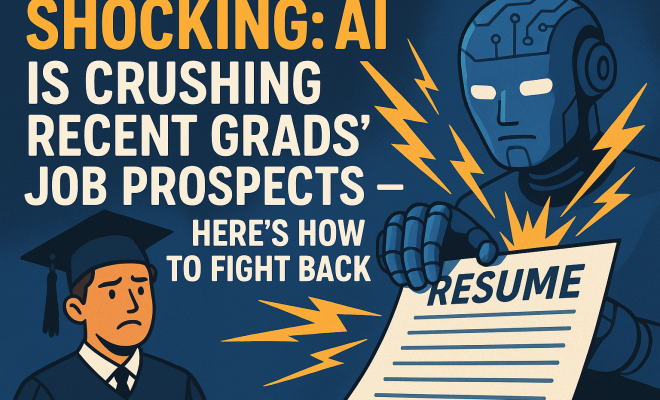
Shocking: AI Is CRUSHING Recent Grads’ Job Prospects – Here’s How to Fight Back
Alright, let’s talk about something that’s probably keeping a lot of you up at night, especially if you’re a student, a recent graduate, or even just someone trying to figure out what the next few decades of work are going to look like. We’re living through a truly unprecedented technological revolution, and the big question on everyone’s mind is: what does this mean for our jobs? Specifically, when it comes to AI vs traditional careers job security, which path is actually going to offer you a safer bet?
A recent study from economists at the U.S. Census Bureau paints a pretty stark picture. They found that since ChatGPT burst onto the scene in November 2022, recent graduates in college majors most exposed to AI have seen a significant hit to their initial earnings and employment prospects. We’re talking about a 5 percentage point drop in the likelihood of landing a job right out of school and a 13% dip in earnings for the most-affected majors. That’s not just a small bump in the road; it’s being compared to graduating into a major recession. Many of these grads are ending up in lower-paying jobs in retail or restaurants, which is definitely not what they signed up for after years of higher education.
This isn’t just a fleeting trend; it’s a seismic shift that’s forcing us to rethink everything we thought we knew about career planning and educational pathways. The traditional four-year degree, once considered a golden ticket, is now under intense scrutiny. It’s no wonder we’re seeing a growing number of Gen Z individuals exploring trade schools and other alternative education routes. They’re looking for hands-on careers that seem less vulnerable to AI’s encroaching reach. This situation highlights a critical need for solid career guidance, effective reskilling programs, and innovative educational models that can genuinely prepare people for the future of work. So, let’s break down exactly what’s happening and how you can position yourself for success in this brave new world.
1. The AI Impact on College Graduates: A Harsh Reality Check
The numbers don’t lie, and they’re particularly sobering for recent college graduates whose fields are highly susceptible to AI integration. Before ChatGPT, the narrative was often about how AI would augment human capabilities, not outright replace them, especially in knowledge-based professions. But the post-November 2022 data suggests a much more aggressive displacement. Imagine spending four or more years, not to mention a mountain of tuition debt, only to find your entry-level job prospects significantly diminished and your starting salary slashed by over 10%. It’s a bitter pill to swallow.
This isn’t merely about automation taking over repetitive tasks on an assembly line; we’re talking about AI systems now capable of generating text, code, images, and even performing complex data analysis that used to be the exclusive domain of educated professionals. Majors heavily reliant on these types of cognitive tasks are feeling the pinch most acutely. Graduates who once expected to walk into well-paying roles in areas like content creation, data entry, or certain analytical positions are finding those doors either closed or leading to significantly less lucrative opportunities. This puts immense pressure on universities to adapt their curricula and guidance counselors to provide more realistic advice.
2. Defining AI vs Traditional Careers Job Security: What Does ‘Secure’ Even Mean Anymore?
The concept of job security itself is undergoing a radical redefinition. For decades, a ‘secure job’ often meant a stable position in a large corporation, perhaps with a pension, or a professional role requiring specific licenses and extensive training. Think doctors, lawyers, accountants, or even skilled trades like electricians and plumbers. These roles were seen as relatively insulated from economic downturns or technological shifts.
Now, however, the landscape is far more complex. While direct patient care or hands-on skilled trades still enjoy a high degree of AI-resistance due to their inherent need for human empathy, physical dexterity, and complex, unpredictable problem-solving, other traditional white-collar professions are facing existential questions. AI can now draft legal documents, diagnose certain medical conditions, and automate significant portions of accounting tasks. So, when we talk about AI vs traditional careers job security, we’re really asking: which careers demand uniquely human attributes that AI simply cannot replicate, and which ones are built on tasks that AI can perform faster, cheaper, and often more accurately?
3. The Rise of Trade Schools and Vocational Training: A Pragmatic Pivot
One of the most telling responses to this AI-driven shift is the resurgence of interest in trade schools and vocational training programs. For many Gen Z individuals, the allure of a four-year degree is dimming when the promise of immediate, secure employment is no longer guaranteed. Instead, they’re looking at professions like HVAC repair, plumbing, electrical work, welding, and medical assisting – fields that require physical presence, hands-on problem-solving, and a human touch.
These careers offer several compelling advantages. First, they often require less time and financial investment than a traditional bachelor’s degree. Second, they frequently lead to immediate employment upon certification, often with competitive wages. Third, and perhaps most crucially in this discussion, they are inherently difficult for AI or automation to fully replace. You can’t remotely fix a leaky pipe with an algorithm, nor can a robot diagnose and repair a complex electrical system in a home or business. The demand for skilled tradespeople remains consistently high, making them a very attractive option for those prioritizing tangible job security. (See: U.S. Census Bureau data.)
4. High-Skill, Human-Centric Roles: The Enduring Value of Empathy and Creativity
While some traditional white-collar jobs are under threat, others, particularly those requiring high levels of human interaction, empathy, creativity, and strategic thinking, are likely to thrive. Consider professions in healthcare that involve direct patient interaction and complex decision-making, such as nurses, therapists, and specialized doctors. While AI can assist with diagnostics, the compassionate care, critical thinking in unpredictable situations, and interpersonal skills of a human healthcare provider are irreplaceable.
Similarly, roles in education, particularly those focused on mentoring, inspiring, and fostering critical thinking in students, remain profoundly human. My own experience as a K-12 teacher, and later as a Dean and Professor, taught me that education is fundamentally about human connection and understanding individual learning styles – something AI can supplement but not replicate. Creative fields like art, music, writing (especially nuanced, human-centered storytelling), and innovative design also fall into this category, as do strategic leadership roles that require complex negotiation, ethical judgment, and visionary thinking. These are the arenas where humans will continue to hold a distinct advantage. For more context, see AI's impact on children and online safety.
5. The Reskilling Revolution: Adapting for Longevity in AI-Dominated Fields
For those already in careers heavily impacted by AI, or for graduates whose majors now face headwinds, the answer isn’t necessarily to abandon ship entirely. Instead, it’s about embracing a mindset of continuous learning and reskilling. The key is to identify which parts of your job AI can automate and then pivot your skills towards the higher-order, uniquely human aspects that AI can’t touch.
This might mean moving from routine data analysis to interpreting complex AI-generated insights, or from basic content creation to strategic content planning and ethical AI deployment. Programs focused on data science, prompt engineering, AI ethics, cybersecurity, and human-AI collaboration are becoming increasingly vital. Companies and individuals need to invest in these reskilling initiatives, recognizing that a workforce capable of working *with* AI, rather than being replaced *by* it, will be the most resilient. This is where online education platforms, career training companies, and personal finance advisors offering guidance on investing in AI-resistant skills, find strong monetization opportunities.
6. Entrepreneurship and Niche Specialization: Carving Your Own Path
In an unpredictable job market, entrepreneurship and highly specialized niche skills offer another avenue for enhanced job security. AI is excellent at handling general tasks and processing vast amounts of data, but it often struggles with highly specific, bespoke problems that require creative solutions or a deep understanding of human psychology and market nuances. This is where human entrepreneurs can truly shine.
Starting your own business, especially one that leverages AI as a tool rather than being threatened by it, can provide a degree of autonomy and control over your career trajectory that traditional employment often lacks. Furthermore, developing a unique, highly specialized skill set – something that combines technical expertise with a creative flair or a deep understanding of a particular human need – can make you indispensable. Think about a graphic designer who specializes in AI-generated art prompts, or a marketing consultant who helps businesses ethically integrate AI into their campaigns. These niche experts will be in high demand.
7. The Critical Role of Education Reform and Career Guidance: Preparing the Next Generation
The alarming data for recent graduates underscores a critical failing in our current educational system and career guidance mechanisms. We simply aren’t preparing students adequately for the realities of an AI-dominated job market. There’s an urgent need for educators, policymakers, and industry leaders to collaborate on comprehensive reforms.
This means integrating AI literacy and ethical considerations into all curricula, not just computer science programs. It means emphasizing critical thinking, creativity, problem-solving, and emotional intelligence – the very skills AI struggles with. It also means strengthening vocational pathways, making them just as prestigious and well-funded as traditional college tracks. Furthermore, career counselors need up-to-the-minute information on job market trends and the impact of AI, moving beyond outdated advice to help students make genuinely informed choices about their futures. Without these systemic changes, we risk creating a generation of graduates ill-equipped for the challenges ahead, further exacerbating the concerns around AI vs traditional careers job security.
8. The Shifting Economic Landscape: Beyond Individual Careers
It’s not just about individual career choices; the entire economic landscape is undergoing a profound transformation. We’re seeing industries restructure, supply chains optimize with AI, and even the nature of consumer demand shifting as AI influences recommendations and product development. This broad economic shift has ripple effects on job creation and destruction across all sectors. Governments and businesses are increasingly grappling with how to manage this transition, often exploring concepts like universal basic income (UBI) or significant investments in public works projects to offset potential job losses from automation. The conversation around AI vs traditional careers job security isn’t just a personal one; it’s a societal challenge that demands large-scale policy responses.
Consider the manufacturing sector, for example. While automation has been a factor for decades, AI is taking it to a new level. Smart factories can now optimize production, predict maintenance needs, and even manage logistics with minimal human intervention. This doesn’t mean all manufacturing jobs disappear, but it changes the skill set required. Instead of manual labor, roles shift towards overseeing complex AI systems, programming robots, and managing data analytics. This redefines what a “traditional” manufacturing career entails and emphasizes the need for a highly skilled, tech-savvy workforce.
9. The Ethical Imperative: AI Bias and Human Oversight
As AI becomes more integrated into decision-making processes, from hiring to loan applications, the issue of AI bias becomes paramount. AI systems are trained on vast datasets, and if those datasets reflect existing societal biases, the AI will perpetuate and even amplify them. This creates a critical need for human oversight, ethical AI developers, and professionals who can audit and mitigate bias in AI algorithms. These are roles that require not just technical expertise but also a deep understanding of sociology, ethics, and human rights – skills AI cannot possess. (See: New York Times coverage on job market.)
Think about the legal field. While AI can draft contracts, a human lawyer is still essential for identifying potential biases in AI-generated legal documents, understanding the nuanced ethical implications of a case, and advocating passionately for a client in court. Similarly, in healthcare, an AI might suggest a diagnosis, but a human doctor must consider the patient’s individual circumstances, cultural background, and emotional state when deciding on a treatment plan. The ethical dimension of AI creates new, highly secure roles for humans who can ensure fairness, transparency, and accountability in our increasingly AI-driven world.
10. Soft Skills: The Unsung Heroes of Job Security
In the face of rapidly advancing AI, the so-called “soft skills” are becoming the hardest and most valuable skills to possess. Things like critical thinking, problem-solving, adaptability, emotional intelligence, communication, and collaboration are inherently human and incredibly difficult for AI to replicate meaningfully. AI can process information, but it can’t truly innovate in the way a human team brainstorms, builds consensus, and brings diverse perspectives to a challenge. For more context, see the effects of technology on education.
My time in education has shown me that fostering these skills isn’t just about passing tests; it’s about developing well-rounded individuals who can navigate complex social and professional environments. A project manager who excels at mediating team conflicts, a salesperson who builds genuine rapport with clients, or a teacher who inspires a love of learning – these roles leverage uniquely human capabilities that AI can only mimic, not truly embody. Investing in the development of these soft skills, both personally and through educational institutions, is a powerful strategy for enhancing job security in any career path.
11. Gig Economy and Portfolio Careers: Diversifying Your AI-Resistance
The traditional model of a single, lifelong career with one employer is steadily eroding. The rise of the gig economy and “portfolio careers” – where individuals leverage multiple income streams and diverse projects – offers another strategy for mitigating AI-related job insecurity. Instead of putting all your eggs in one basket, you can diversify your skill set and client base, making you less vulnerable if one specific area becomes heavily automated.
For example, a freelance writer might combine AI-assisted content generation for routine tasks with highly specialized, human-led creative storytelling for premium clients. An independent consultant might offer services in both AI implementation and change management, blending tech expertise with essential human-centric skills. This approach requires a proactive, entrepreneurial mindset and a commitment to continuous learning, but it offers a robust defense against the volatility of the AI-driven job market. It shifts the focus from finding a “secure job” to building a “secure career ecosystem.”
12. Global Perspectives on AI and Employment: A Varied Outlook
It’s important to remember that the impact of AI on job security isn’t uniform across the globe. Different countries, with varying economic structures, labor laws, and educational systems, will experience the AI revolution in unique ways. Developed nations with service-oriented economies might see a greater impact on white-collar jobs, while developing nations with large manufacturing sectors might face different challenges related to automation and the shift in global supply chains.
For instance, countries investing heavily in AI research and development might see a boom in jobs related to AI creation, maintenance, and ethical oversight, while those slower to adapt might experience greater displacement. Understanding these global trends can offer valuable insights into which skills and industries are likely to be in demand internationally. This broadens the discussion of AI vs traditional careers job security beyond local markets, encouraging a global mindset for career planning and skill development.
Frequently Asked Questions About AI vs Traditional Careers Job Security
Q1: Are all traditional careers at risk from AI?
No, definitely not. Careers requiring a high degree of human empathy, creativity, complex physical dexterity, ethical judgment, or unpredictable problem-solving are generally more resistant. Think about roles in direct patient care, skilled trades, artistic creation, or strategic leadership. AI excels at repetitive, data-driven, or rule-based tasks, so careers heavily reliant on those are more susceptible.
Q2: Should I avoid college majors that are exposed to AI?
Not necessarily. The key isn’t to avoid AI-exposed fields entirely, but to choose programs that emphasize critical thinking, creativity, and human-AI collaboration. If your major involves tasks AI can automate, focus on developing higher-order skills like interpreting AI outputs, ethical considerations, and strategic application. Many majors that seem exposed can become highly valuable if you pivot towards the human-centric aspects of the work. For more context, see Michigan's cell phone ban and student success. (See: BBC insights on AI impact.)
Q3: What are some examples of “AI-resistant” jobs?
Good question! Examples include plumbers, electricians, HVAC technicians, nurses, therapists, teachers (especially those focused on mentorship and critical thinking), artists, musicians, strategic business leaders, and ethicists. Essentially, any job that truly needs a human touch, on-the-spot physical problem-solving, or deep emotional intelligence tends to be more secure.
Q4: How can I future-proof my career against AI?
The best way to future-proof your career is through continuous learning and adaptability. Focus on developing “human” skills like creativity, critical thinking, emotional intelligence, and complex problem-solving. Also, consider reskilling in areas like AI ethics, prompt engineering, data interpretation, or cybersecurity. Diversifying your income streams through entrepreneurship or a portfolio career can also add security.
Q5: Is a trade school a better option than a four-year degree now?
For many, trade schools offer a compelling, pragmatic path to job security. They often require less time and financial investment, lead to immediate employment, and focus on hands-on skills that are difficult for AI to replicate. Whether it’s “better” depends on your individual aptitudes, interests, and career goals. Both pathways can lead to secure and fulfilling careers, but the landscape is certainly favoring practical, AI-resistant skills more than ever.
Q6: Will AI create new jobs, or only destroy them?
AI will definitely create new jobs, but the challenge is that the jobs it creates often require different, higher-level skills than those it displaces. We’ll see roles in AI development, maintenance, ethics, and human-AI interaction. The key is ensuring that the workforce can adapt and acquire these new skills through education and reskilling initiatives. The net effect on job numbers is still a subject of debate, but the nature of work will undeniably change.
Q7: What role does government play in addressing AI’s impact on job security?
Governments have a crucial role. They need to invest in education reform, vocational training, and reskilling programs. They might also need to consider social safety nets like universal basic income, explore policies that encourage businesses to retain and retrain workers, and establish ethical guidelines for AI deployment. It’s a complex societal issue, not just an individual one.
The shift we’re witnessing is profound, and it’s not going to slow down. While the initial data for recent graduates in AI-exposed majors is concerning, it’s also a powerful call to action. It forces us to reconsider the value proposition of different career paths and to prioritize skills that are genuinely AI-resistant or AI-complementary. Whether it’s through the hands-on security of a trade, the human-centric focus of a caregiving role, continuous reskilling, or entrepreneurial innovation, the future of work demands adaptability and a clear-eyed understanding of what truly makes us indispensable in an intelligent machine’s world.
Trending Now
Frequently Asked Questions
How is AI impacting job prospects for recent graduates?
AI is significantly affecting job prospects for recent graduates, especially in fields vulnerable to automation. A study found a 5% decrease in job placement and a 13% drop in earnings for graduates in these majors since the rise of AI technologies like ChatGPT.
What are some alternative career paths for graduates facing AI challenges?
Graduates are increasingly exploring alternative career paths, such as trade schools and hands-on professions that are less susceptible to AI disruption. These options provide practical skills and job security in a rapidly changing job market.
Should I still pursue a four-year degree in light of AI advancements?
While a four-year degree has traditionally been seen as a key to success, the rise of AI is prompting many to reconsider this path. It's essential to evaluate your field of interest and explore additional skills or alternative education that may offer better job security.
What steps can recent grads take to improve their job prospects?
Recent grads can enhance their job prospects by focusing on reskilling, gaining hands-on experience, and exploring fields less affected by AI. Networking, internships, and pursuing certifications in emerging industries can also be beneficial.
How can educational institutions adapt to the rise of AI in the job market?
Educational institutions need to innovate by offering career guidance, effective reskilling programs, and curricula that prepare students for future job markets. Emphasizing practical skills and adaptability will help students thrive in an AI-influenced economy.
Agree or disagree? Drop a comment and tell us what you think.