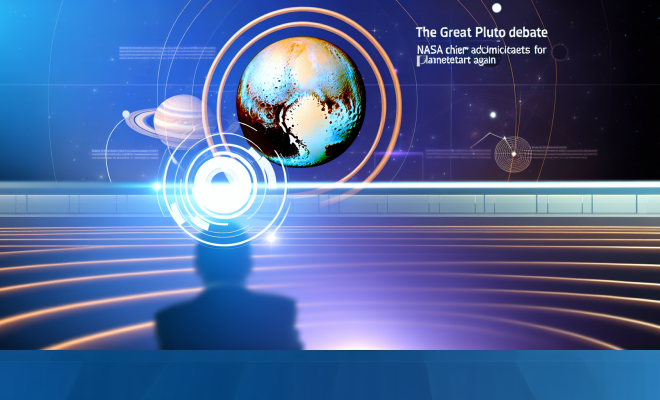
The Great Pluto Debate: NASA Chief Advocates for Planetary Reinstatement
Introduction
The status of Pluto has long been a contentious issue in the realm of astronomy, igniting passionate discussions among scientists, enthusiasts, and the general public alike. Recently, the debate has taken on new vigor as NASA Administrator Jared Isaacman has publicly expressed his support for Pluto’s reinstatement as a full-fledged planet. This statement, made during a testimony before lawmakers, challenges the 2006 International Astronomical Union (IAU) decision that reclassified Pluto as a dwarf planet. As discussions around this topic heat up, it’s essential to explore the history, implications, and criteria surrounding planetary classification.
The Historical Context
To understand the current debate, it’s important to look back at how Pluto’s classification has evolved over time. Discovered in 1930 by Clyde Tombaugh, Pluto was initially hailed as the ninth planet of our solar system. For over seven decades, it held this status until the dawn of the 21st century when astronomers began to reevaluate the definitions of what constitutes a planet.
The 2006 Reclassification
In August 2006, the IAU convened in Prague to establish a formal definition of a planet. The outcome was a new classification that excluded Pluto from the planet category. According to the IAU:
- A planet must orbit the sun.
- A planet must be spherical in shape due to its own gravity.
- A planet must have cleared its orbit of other debris.
Pluto failed to meet the third criterion, as it shares its orbital neighborhood with other objects in the Kuiper Belt. Consequently, it was demoted to a dwarf planet, a classification that includes other celestial bodies such as Eris and Haumea.
The Implications of Reclassification
The decision to reclassify Pluto was met with widespread backlash and disappointment, particularly among the public and many in the scientific community. For many, Pluto has always been a planet, representing a significant chapter in the story of our solar system. The emotional connection to Pluto has fueled a movement advocating for its reinstatement.
Impact on Education and Public Perception
The reclassification of Pluto has also had implications for education. Textbooks and educational materials had to be revised, leading to confusion among students and educators alike. Many children who learned about the solar system were left disheartened by the news that their beloved ninth planet was no longer recognized as such.
Jared Isaacman’s Position
During his recent testimony, Jared Isaacman voiced his support for Pluto’s return to planet status, reigniting the debate among astronomers and space enthusiasts. Isaacman, known for his role as an entrepreneur and private astronaut, emphasized the need for a reevaluation of the criteria used to define planets.
A Call for Redefining Criteria
Isaacman’s statement has sparked discussions about whether the current criteria for planetary classification are too rigid. He argued that the emotional and cultural significance of Pluto should not be overlooked. As we delve deeper into our solar system and discover more about the objects within it, it may be time to reconsider how we define a planet.
Scientific Perspectives
The scientific community remains divided over the issue of Pluto’s status. Some astronomers support Isaacman’s call for a reevaluation, while others argue that the IAU’s criteria provide a necessary framework for classification.
Arguments for Pluto’s Reinstatement
- Cultural Significance: Pluto holds a special place in popular culture, symbolizing exploration and discovery.
- Scientific Interest: Pluto is a unique world with its own geological features, atmospheres, and moons, making it worthy of study as a planet.
- Expanding Knowledge: As our understanding of celestial bodies evolves, so too should our definitions.
Arguments Against Reinstatement
- Consistency in Classification: Maintaining a clear and consistent definition of a planet helps in the study and understanding of our solar system.
- Scientific Rigor: The current criteria are based on observable characteristics that can be objectively measured.
- Precedent: Reinstating Pluto could open the floodgates for other celestial bodies to demand similar recognition, complicating the classification system.
Public Reactions and Support
Since Isaacman’s statement, public support for Pluto’s reinstatement has surged. Petitions have emerged online, rallying thousands of signatures in favor of reclassifying Pluto as a planet. Social media platforms have been flooded with discussions, memes, and polls asking whether Pluto should regain its planetary status.
The Role of Advocacy Groups
Organizations dedicated to space education and advocacy have also jumped into the fray. Groups like the Planetary Society and various astronomy clubs are encouraging conversations about planetary classification and its implications for science education.
Future of Pluto and Planetary Classification
As the debate continues, it raises broader questions about how we define celestial bodies and the criteria we use. The possibility of a new IAU meeting to address the classification of Pluto has been discussed, but as of now, no formal plans have been set in motion.
New Discoveries and Technological Advances
With missions like NASA’s New Horizons, which flew by Pluto in July 2015, our understanding of this distant world has expanded significantly. The data collected has revealed a complex and dynamic environment, showcasing the potential for more discoveries that could influence future classifications.
Conclusion
The debate over Pluto’s status is far from over. As NASA Administrator Jared Isaacman’s statement suggests, the conversation is evolving, with new voices advocating for a reassessment of what it means to be a planet. Whether or not Pluto will regain its status as the ninth planet in our solar system remains uncertain, but what is clear is that Pluto will continue to hold a special place in the hearts and minds of many. As we venture further into the cosmos, the discussions around Pluto—and the criteria that define planetary status—will likely remain a topic of interest and contention.