The Edvocate

Top Menu

Main Menu

  • Start Here
    • Our Brands
    • Governance
      • Lynch Education Consulting, LLC.
      • Dr. Lynch’s Personal Website
      • Careers
    • Write For Us
    • Books
    • The Tech Edvocate Product Guide
    • Contact Us
    • The Edvocate Podcast
    • Edupedia
    • Pedagogue
    • Terms and Conditions
    • Privacy Policy
  • PreK-12
    • Assessment
    • Assistive Technology
    • Best PreK-12 Schools in America
    • Child Development
    • Classroom Management
    • Early Childhood
    • EdTech & Innovation
    • Education Leadership
    • Equity
    • First Year Teachers
    • Gifted and Talented Education
    • Special Education
    • Parental Involvement
    • Policy & Reform
    • Teachers
  • Higher Ed
    • Best Colleges and Universities
    • Best College and University Programs
    • HBCU’s
    • Diversity
    • Higher Education EdTech
    • Higher Education
    • International Education
  • Advertise
  • The Tech Edvocate Awards
    • The Awards Process
    • Finalists and Winners of The 2026 Tech Edvocate Awards
    • Finalists and Winners of The 2025 Tech Edvocate Awards
    • Finalists and Winners of The 2024 Tech Edvocate Awards
    • Finalists and Winners of The 2023 Tech Edvocate Awards
    • Finalists and Winners of The 2021 Tech Edvocate Awards
    • Finalists and Winners of The 2022 Tech Edvocate Awards
    • Finalists and Winners of The 2020 Tech Edvocate Awards
    • Finalists and Winners of The 2019 Tech Edvocate Awards
    • Finalists and Winners of The 2018 Tech Edvocate Awards
    • Finalists and Winners of The 2017 Tech Edvocate Awards
    • Award Seals
  • Apps
    • GPA Calculator for College
    • GPA Calculator for High School
    • Cumulative GPA Calculator
    • Grade Calculator
    • Weighted Grade Calculator
    • Final Grade Calculator
  • The Tech Edvocate
  • Post a Job
  • AI Powered Personal Tutor

logo

The Edvocate

  • Start Here
    • Our Brands
    • Governance
      • Lynch Education Consulting, LLC.
      • Dr. Lynch’s Personal Website
        • My Speaking Page
      • Careers
    • Write For Us
    • Books
    • The Tech Edvocate Product Guide
    • Contact Us
    • The Edvocate Podcast
    • Edupedia
    • Pedagogue
    • Terms and Conditions
    • Privacy Policy
  • PreK-12
    • Assessment
    • Assistive Technology
    • Best PreK-12 Schools in America
    • Child Development
    • Classroom Management
    • Early Childhood
    • EdTech & Innovation
    • Education Leadership
    • Equity
    • First Year Teachers
    • Gifted and Talented Education
    • Special Education
    • Parental Involvement
    • Policy & Reform
    • Teachers
  • Higher Ed
    • Best Colleges and Universities
    • Best College and University Programs
    • HBCU’s
    • Diversity
    • Higher Education EdTech
    • Higher Education
    • International Education
  • Advertise
  • The Tech Edvocate Awards
    • The Awards Process
    • Finalists and Winners of The 2026 Tech Edvocate Awards
    • Finalists and Winners of The 2025 Tech Edvocate Awards
    • Finalists and Winners of The 2024 Tech Edvocate Awards
    • Finalists and Winners of The 2023 Tech Edvocate Awards
    • Finalists and Winners of The 2021 Tech Edvocate Awards
    • Finalists and Winners of The 2022 Tech Edvocate Awards
    • Finalists and Winners of The 2020 Tech Edvocate Awards
    • Finalists and Winners of The 2019 Tech Edvocate Awards
    • Finalists and Winners of The 2018 Tech Edvocate Awards
    • Finalists and Winners of The 2017 Tech Edvocate Awards
    • Award Seals
  • Apps
    • GPA Calculator for College
    • GPA Calculator for High School
    • Cumulative GPA Calculator
    • Grade Calculator
    • Weighted Grade Calculator
    • Final Grade Calculator
  • The Tech Edvocate
  • Post a Job
  • AI Powered Personal Tutor
  • Alarming: Viral Video Exposes Chilling School Safety Concerns — What Every Parent Needs to Know Now

  • Disturbing: Parents Allege Texas Daycare Ran ‘Child Fight Club’ — See the Horrifying Details

  • Devastating New US Teens Education Report: AI Blamed as Reading Plummets 14 Points

  • This Teacher’s Radical Idea Could Reshape Education For Millions – And Sparked a Furious Viral Social Media Education Debate

  • Catastrophic: The True Cost of Layoffs at University Jobs is Far Worse Than You Think

  • 7 Critical Online Courses for Upskilling After Layoffs — Don’t Get Left Behind!

  • The Brutal Reality of University Layoffs: 8 Ways to Rebound After Losing Your Job

  • Catastrophic: University of Maine’s $19M Shortfall Spells Disaster for Faculty

  • Explosive Court Ruling: Your Guide to Securing Teacher Preparation Grants Now

  • Staggering Victory: How Reinstated Funding Will Transform Teacher Prep & Your Career

EdTech & Innovation
Home›EdTech & Innovation›KIBO Advanced Coding Set: Next-Level Robotics for Kids

KIBO Advanced Coding Set: Next-Level Robotics for Kids

By Chris Piehler
May 30, 2019
0
Spread the love

The KIBO Advanced Coding Extension Set unlocks new coding options to allow users of the robot kit to design their own programming blocks, create their own games, and explore complex coding concepts

(Waltham, MA) May 30, 2019 – KinderLab Robotics today expands its KIBO™ line by announcing its newest product, the Advanced Coding Extension Set, and an accompanying curriculum guide, Ask and Imagine. The Advanced Coding Extension Set supports children who are experienced with KIBO’s core concepts and offers them the next step along their computer science pathways. The Advanced Coding Extension Set creates a bridge between KIBO’s core pre-K to 2nd-grade curriculum and the computer science and engineering work students will do in upper elementary and beyond. Children can explore advanced computer science concepts such as subroutines, randomness, and conditionals, while staying rooted in KIBO’s familiar screen-free, hands-on coding environment.

KIBO is a robot kit specifically designed for children ages 4–7 years old. KIBO is entirely screen-free, as children program their robots with “tangible code” made of wooden programming blocks. Through these physical materials, children engage with a range of powerful ideas found in STEAM, computer science, and design thinking, all while integrating directly with literacy and art curricula.

The Advanced Coding Set allows children—and their teachers—to extend this exploration to computer science concepts that in the past were only accessible by older children. The new programming blocks unlock new powerful ideas: modularity and reusability with subroutines, complex conditional behavior, and randomness.

Carmella Hughes, a technology integration specialist at Nathaniel Morton Elementary School in Plymouth, MA, has used the new blocks with her KIBO students. She said, “These new blocks really extend students’ programming choices. My students set up a race for KIBO robot with extension set for advanced coding capabilities.two KIBOs using the RANDOM parameter block. This was a favorite! This let me lead them through a very natural integration of math and engineering standards. Students could record their distances given 5, 10, 20, etc. tries. What happens with probability as the number of attempts increases? These new options really expand the boundaries of what we can do with KIBO in the classroom.”
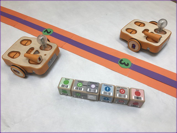
Creativity and personal expression remain at the heart of this new Extension Set and the Ask and Imagine curriculum booklet. Jason Innes, the manager of training and curriculum development at KinderLab Robotics, Inc., said, “At KinderLab, we focus on creative coding and robotics experiences for early childhood. Anyone familiar with KIBO can have fun with this new Extension Set, creating their own programming blocks and inventing new games. At the same time, we see KIBO as a vital on-ramp to a comprehensive computer science pathway for all students that extends into upper elementary and beyond. With the Advanced Coding Extension Set, we give students the ability to go beyond the computer science standards typically associated with the pre-K–2nd grade range.”

The new Advanced Coding Extension Set unlocks three new programming options:

Subroutines: A subroutine is like a miniature program within a program. With KIBO’s subroutines, children create their own programming block by defining a sequence of commands then assigning that sequence to a subroutine block. To personalize their creation, children can even use an included erasable marker to draw their own icon right onto the programming block sticker. The set includes multiple blocks to call the subroutines, allowing students to dive into the powerful ideas of modularity and reusability.

Random Parameter: This new card makes KIBO’s repeat loop run a random number of times. Kids can teach KIBO to play “Duck, Duck, Goose”—spin KIBO a random number of times, and who knows who will be “it”?

If Not: Children can already design programs that respond to light, sound, and distance using KIBO’s conditional programming. The new “If Not” block lets children tell KIBO to do one thing if a sensor is triggered, and something else if it’s not. This foundational concept in computer science expands the expressive possibilities for KIBO while deepening students’ understanding of conditional programming.

The Advanced Coding Extension Set is available for pre-order now for $80. During the pre-order period, KinderLab is offering a special: order two or more sets and receive the Advanced Coding Curriculum Guide Ask and Imagine (a $25 value) at no cost (limit one free Curriculum Guide per customer). The sets and curriculum will ship on June 24, 2019.

About KIBO – The Playful STEAM Robot

KIBO is a robot kit that allows children aged 4–7 to build, program, decorate, and bring their own robot to life without requiring any screen time on a smartphone, tablet, or computer. It is an open platform on which students can envision and create their own robot. With art and engineering, students transform KIBO into imagined animals, vehicles, storybook characters, and more. Students plan a coding sequence using wooden programming blocks, then scan their sequence with the built-in barcode scanner, press its button—and the robot comes alive. KIBO is a Winner in the Technology/Preschool category in the 2018 Seriously STEM awards, as well as numerous other awards.

When children build, code, and decorate their own robot, they perceive it as play, but they are learning invaluable STEAM skills. Not only are these hands-on experiences inherently rewarding, but they help children understand the technology in their world, and can even improve their future job prospects.

About KinderLab Robotics, Inc.

KinderLab Robotics is the creator of the award-winning KIBO, a playful educational STEAM robot kit based on 20 years of child development research with thousands of children, teachers, and parents. Developed specifically for teachers by Dr. Marina Umaschi Bers at Tufts University, KIBO is currently used in 57 countries and has proven efficacy in helping kids learn STEAM—and getting them excited about it! KinderLab offers a complete suite of teaching materials that help integrate STEAM elements into a wide range of curricula, including art, cultural studies, and reading literacy.

For more information, please visit KinderLabRobotics.com.

Press Contact

Chris Piehler

PR with Panache!

[email protected]

Previous Article

Instilling a Love of Learning in Your ...

Next Article

Build Academic Success: A Foundation for Your ...

Chris Piehler

Related articles More from author

  • EdTech & InnovationMatthew LynchTeaching Strategies, Tactics, and Methods

    The Evolving Business of Lesson Plans: Buy, Borrow, or Create?

    February 12, 2016
    By Matthew Lynch
  • EdTech & InnovationMatthew Lynch

    2 Bold Moves Made By Pearson Education in 2015

    December 1, 2015
    By Matthew Lynch
  • EdTech & InnovationTeachers

    The value of student and teacher input in EdTech

    June 9, 2016
    By Matthew Lynch
  • EdTech & Innovation

    21 EdTech Interview Questions to Find Top Talent

    February 4, 2019
    By Matthew Lynch
  • EdTech & Innovation

    BookNook Approved as High-Quality Tutoring Program in Ohio 2022

    November 17, 2022
    By Chris Piehler
  • EdTech & Innovation

    Leverage Learner Variability for EdTech Equity

    April 12, 2022
    By Matthew Lynch

Search

Registration and Login

  • Log in
  • Entries feed
  • Comments feed
  • WordPress.org

Newsletter

Signup for The Edvocate Newsletter and have the latest in P-20 education news and opinion delivered to your email address!

RSS feed: Matthew on Education Week Matthew on Education Week

  • Au Revoir from Education Futures November 20, 2018 Matthew Lynch
  • 6 Steps to Data-Driven Literacy Instruction October 17, 2018 Matthew Lynch
  • Four Keys to a Modern IT Approach in K-12 Schools October 2, 2018 Matthew Lynch
  • What's the Difference Between Burnout and Demoralization, and What Can Teachers Do About It? September 27, 2018 Matthew Lynch
  • Revisiting Using Edtech for Bullying and Suicide Prevention September 10, 2018 Matthew Lynch

About Us

The Edvocate was created in 2014 to argue for shifts in education policy and organization in order to enhance the quality of education and the opportunities for learning afforded to P-20 students in America. What we envisage may not be the most straightforward or the most conventional ideas. We call for a relatively radical and certainly quite comprehensive reorganization of America’s P-20 system.

That reorganization, though, and the underlying effort, will have much to do with reviving the American education system, and reviving a national love of learning.  The Edvocate plans to be one of key architects of this revival, as it continues to advocate for education reform, equity, and innovation.

Newsletter

Signup for The Edvocate Newsletter and have the latest in P-20 education news and opinion delivered to your email address!

Contact

The Edvocate
910 Goddin Street
Richmond, VA 23230
(601) 630-5238
[email protected]
  • situs togel online
  • dentoto
  • situs toto 4d
  • situs toto slot
  • toto slot 4d
Copyright (c) 2026 Matthew Lynch. All rights reserved.