What’s Next in Education: K-12 and Higher Ed Leaders on 2027
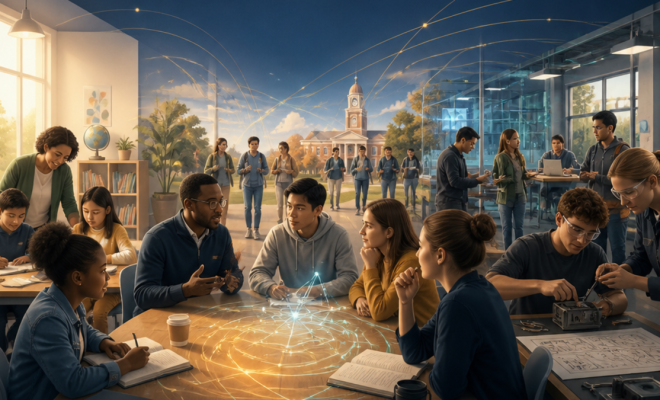
As we approach 2027, education is poised for transformative change shaped by the evolving role of technology, shifting student demographics, and new approaches to teaching and learning. From K-12 classrooms to higher education institutions, leaders are grappling with how to harness artificial intelligence (AI), improve student outcomes, and address systemic challenges such as enrollment declines and equity gaps. To explore what lies ahead, we turn to insights from top experts who are shaping the future of education technology, policy, and pedagogy.
K-12 Education: From Screen Time Debates to Coherent, Outcomes-Focused EdTech
Rethinking Screen Time: Focusing on Meaningful Cognitive and Social Engagement
Dacia Toll, Co-Founder and Co-CEO of Coursemojo, envisions a more nuanced conversation about technology use in K-12 education by 2027. The focus will shift from simply measuring screen time to evaluating the quality of students’ interactions with technology.
“In middle and high school, the central question won’t be whether tech is involved, but what kind of cognitive and social experience students are having with the technology. Does it ask them to think more deeply, revise their ideas, and engage effectively with peers, or does it make learning more passive and isolating?”
— Dacia Toll
This shift reflects a growing awareness that technology’s value lies in how it supports critical thinking, collaboration, and active learning rather than just its presence in the classroom.
The Rise of Coherent EdTech Ecosystems
Toll highlights that schools will increasingly seek edtech solutions that unify curriculum, professional development, assessment, and intervention into a coherent system designed to support both student and teacher success.
“Schools will be looking for coherent solutions that unite curriculum, professional development, assessment, and intervention – all in service of student and teacher success.”
This coherence will help districts avoid fragmented technology adoption and ensure that tools are aligned with learning goals and outcomes.
Outcomes-Based Contracting and Community Investment
Another emerging trend Toll identifies is the growth of outcomes-based contracting, where districts expect edtech partners to share responsibility for results, not just usage metrics.
“Outcomes-based contracting will continue to grow as districts expect edtech partners to share responsibility for results, not just usage.”
Additionally, Toll foresees more governors adopting Education Freedom Tax Credits, which convert taxpayers into philanthropists who can invest in innovative educational opportunities for high-needs students, including those in public schools.
“More Governors will opt into Education Freedom Tax Credits and will turn millions of their taxpayers into philanthropists, allowing us to invest in our communities and create exciting new opportunities for high-needs students.”
AI Governance and the Shift from Compliance to Intelligence
Aaron Feuer, CEO and Co-Founder of Panorama Education, stresses the importance of governance in AI adoption within K-12 systems.
“Standalone AI tools fail without district context. The future of AI in K-12 education lies in shifting from compliance to intelligence — using AI not just to meet regulations but to truly understand and support student needs.”
— Aaron Feuer
Feuer points out that many AI tools deployed in schools operate in isolation, which limits their effectiveness. Instead, AI must be integrated thoughtfully within district strategies to drive meaningful insights and improvements in student support.
Higher Education: Navigating the Enrollment Cliff and Embracing AI
The Enrollment Cliff and AI’s Impact on Admissions
Kevin Krebs, Founder and Managing Director of HelloCollege, identifies two intersecting challenges in higher education: declining enrollment and the growing use of AI in admissions.
“With many schools missing their enrollment goals, and many students using AI to help complete their applications and essays, universities are being forced to adapt to both.”
— Kevin Krebs
In response, some universities are reducing or eliminating college essays to combat AI-assisted applications and to simplify the process for students. Others are offering direct admission pathways to increase access and boost enrollment.
“Several schools are already eliminating or reducing college essays to combat student AI use and make the application process less daunting. We will also see many more universities offering direct admission to increase college access and boost their lagging enrollment numbers.”
New Methods to Assess Authenticity and Critical Thinking
Krebs predicts that 2027 will see a rise in innovative admissions practices such as timed video responses to essays, which help institutions assess student authenticity and critical thinking skills.
“To help assess a student’s authenticity and ability to think on their feet, I think 2027 will see a growing number of schools rolling out timed video responses to essays.”
This reflects a broader emphasis on problem-solving and critical thinking skills that prepare students for college success and the evolving workforce.
AI Readiness: Building Better Foundations
France Hoang, CEO and Founder of BoodleBox, offers a critical perspective on AI readiness in higher education, arguing that current measures focus too much on tool adoption rather than meaningful integration.
“For the past two years, readiness meant adoption: which tools, which licenses, which prompts. That was never the real question.”
— France Hoang
Hoang uses a metaphor to illustrate the problem:
“A car is only as good as the road beneath it, and right now most institutions have handed faculty a sports car and a 1900s cow path.”
The real work in 2027, she says, is building better “roads” — meaning better infrastructure, training, and culture to support AI use.
“Institutions will stop measuring readiness by tool usage and start measuring it against three things that actually predict outcomes: domain expertise, AI enablement, and human excellence.”
Hoang stresses that AI readiness is fundamentally human readiness — the ability to exercise judgment, discernment, and validation rather than blindly accepting AI outputs.
“The ones treating this as a procurement problem will keep buying faster cars. The ones treating it as a development problem, training people to climb out of the easy-output valley and do the harder work of validating what the machine hands them, will be the institutions still standing out in three years.”
Teaching with AI: From Restriction to Empowerment
Jarred McNeely, VP of Academics at Sonoran Desert Institute, advocates for a shift in the conversation around AI in education — from restricting student use to actively teaching with AI.
“Much of the past few years has gone into restricting how students use AI. The more useful questions now are how faculty can use it to engage a class, how instructional designers can use it to build better learning experiences, and how staff and administrators can use it to understand their data and lead more effectively.”
— Jarred McNeely
McNeely also highlights the unique role of AI in trade education, where students are preparing for careers as tradespeople and business owners.
“AI will become one of their tools. Teaching them to use it responsibly is no different from teaching them to use any other tool of the trade well.”
Beyond the craft itself, AI can help tradespeople manage business functions such as marketing and performance tracking.
“The difference is that AI will help them outside their craft: tracking business performance, handling marketing, and managing a small shop.”
McNeely emphasizes that this potential will only be realized with the right foundational education.
“One of educators’ most important jobs will be guiding students to use AI to understand and solve the real problems they face.”
Key Themes Shaping Education in 2027
1. Quality and Coherence in Technology Use
Across K-12 and higher education, the focus is shifting from technology quantity to quality. Coherent systems that integrate curriculum, assessment, and professional development will replace fragmented edtech adoption.
2. Human-Centered AI Readiness
AI readiness is not just about tools but about cultivating human skills — judgment, discernment, and validation. Institutions that invest in developing these human capacities alongside AI will thrive.
3. Innovative Admissions and Assessment
Higher education will adopt new admissions practices, including direct admissions and video responses, to address enrollment challenges and better evaluate student potential in an AI-influenced world.
4. Trade Education as a Resilient Path
Trade schools will grow in importance, offering flexible, AI-enhanced programs that prepare students for stable, in-demand careers while supporting diverse learners including veterans and career changers.
5. Policy Innovations for Equity
Policies like Education Freedom Tax Credits will empower communities to invest in education, creating new opportunities for underserved students and fostering equity.
Conclusion: Embracing Thoughtful Innovation for Lasting Impact
The future of education in 2027 will be defined by thoughtful integration of AI and technology, a renewed focus on human skills, and innovative approaches to access and assessment. K-12 education will move beyond simplistic screen time debates toward meaningful, coherent edtech ecosystems that support deep learning and social engagement. Higher education will confront enrollment challenges with new admissions strategies and redefine AI readiness as a human-centered development process.
Trade education will emerge as a vital, AI-resilient pathway to stable careers, while policy innovations will expand educational equity and community investment. Ultimately, the success of education’s future depends not on the tools themselves but on how educators, students, and institutions use them to foster critical thinking, authentic learning, and real-world problem-solving.
About the Experts
- Dacia Toll
Co-Founder and Co-CEO, Coursemojo
LinkedIn Profile - Aaron Feuer
CEO and Co-Founder, Panorama Education
LinkedIn Profile - Kevin Krebs
Founder and Managing Director, HelloCollege
LinkedIn Profile - France Hoang
CEO and Founder, BoodleBox
LinkedIn Profile - Jarred McNeely
VP of Academics, Sonoran Desert Institute
LinkedIn Profile