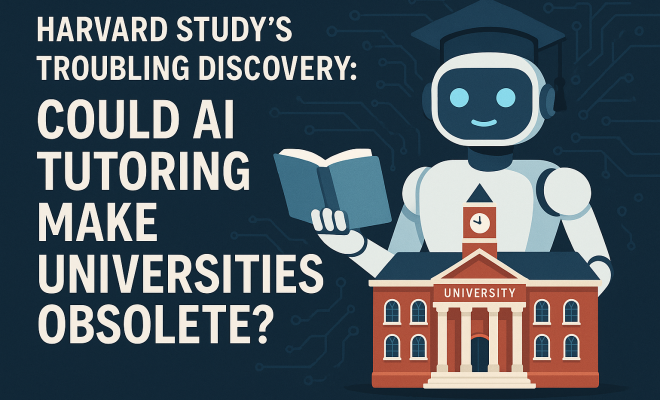
Harvard Study’s Troubling Discovery: Could AI Tutoring Make Universities Obsolete?
“`html
Imagine a world where your most effective teacher isn’t a seasoned professor with decades of experience, but an artificial intelligence. It sounds like something out of a science fiction novel, right? Yet, a recent study from none other than Harvard University has thrown this very possibility into the academic spotlight, sparking a fierce debate about the future of higher education as we know it. The findings are, to put it mildly, provocative, and they’re forcing us to ask some uncomfortable questions about the traditional university model.
The study, which has gone viral and ignited discussions across educational and tech circles, suggests that an AI tutor can not only match but actually surpass the learning outcomes achieved in conventional active-learning classrooms. This isn’t just about minor improvements; we’re talking about significant gains in student understanding and engagement. If a machine can deliver better instructional results, what does that mean for the institutions built on the premise of human-led teaching? It’s a critical moment, and the implications of effective AI tutoring in education are far-reaching.
1. PS2 Pal’s Surprising Triumph: The Harvard Physics Experiment
Let’s dive into the heart of the matter: the Harvard study itself. Led by researchers Gregory Kestin and Kelly Miller, the experiment focused on a physics course for undergraduates. The star of the show was an AI tutor dubbed ‘PS2 Pal.’ This wasn’t just a chatbot; it was a sophisticated system designed to guide students through problem-solving and conceptual understanding, mimicking the personalized attention of a human tutor.
The study involved 194 undergraduates, split into different learning environments. One group engaged in traditional active-learning classrooms, where instructors facilitate discussions and group work. The other group, however, largely interacted with PS2 Pal. The results were quite astonishing: students who used the AI tutor achieved a median post-test score of 4.5, a full point higher than the 3.5 median score recorded by their peers in the classroom group. They also completed their work faster and, crucially, reported higher levels of engagement. This isn’t just an incremental improvement; it’s a stark difference that makes you sit up and take notice.
2. Beyond the Classroom: The Broader Functions of a University
While the Harvard study’s findings on instructional efficacy are compelling, many argue that reducing a university’s value solely to its ability to deliver lectures or facilitate problem-solving misses the bigger picture. Universities are, and have always been, much more than just learning factories. They are crucibles of intellectual development, social hubs, and engines of research and innovation.
Think about it: where do groundbreaking scientific discoveries often happen? In university labs. Where do future leaders forge connections and develop critical thinking skills through debate and diverse perspectives? On college campuses. Universities offer networking opportunities, career services, extracurricular activities, and a vibrant community that fosters personal growth in ways an AI, no matter how sophisticated, simply can’t replicate. The ‘university experience’ is a holistic one, encompassing everything from late-night study sessions in the library to spirited discussions over coffee, all contributing to a student’s development far beyond the acquisition of specific knowledge.
3. The Engagement Enigma: Why Students Loved PS2 Pal
One of the most intriguing aspects of the Harvard study was the reported higher engagement among students using PS2 Pal. This goes against some common assumptions about AI interaction being cold or impersonal. So, what made PS2 Pal so engaging? It likely boils down to a few key factors.
Firstly, personalized learning. An AI tutor can adapt to each student’s pace, identify specific areas of weakness, and provide immediate, tailored feedback. Unlike a classroom setting where an instructor has to cater to an entire group, PS2 Pal could offer a truly individualized learning path. Secondly, the ‘no judgment’ factor. Students might feel more comfortable making mistakes or asking ‘silly’ questions when interacting with an AI, free from the fear of peer judgment or instructor disapproval. This psychological safety can significantly boost participation and deep learning. The ability to retry problems endlessly without embarrassment is also a huge draw. This level of personalized, private, and persistent support is incredibly difficult to achieve consistently in a traditional classroom.
4. The Cost Conundrum: Reimagining Educational Economics with AI Tutoring
Let’s talk about the elephant in the room: the skyrocketing cost of higher education. Tuition fees have been spiraling upwards for decades, leaving many students burdened with crushing debt. This is where the potential of AI tutoring in education truly shines as a disruptor. If AI can deliver superior or even comparable instructional outcomes at a fraction of the cost, the economic model of universities could face an existential crisis.
Imagine a scenario where the core instructional content for many courses could be delivered and supported by AI, drastically reducing the need for large numbers of teaching assistants or even full-time faculty for basic instruction. This could lead to a significant reduction in tuition costs, making quality education accessible to a much wider demographic. While universities still incur costs for infrastructure, research, and administrative functions, the instructional component is a major driver of expenses. The prospect of democratizing access to high-quality, personalized learning through AI is a powerful argument for its widespread adoption, especially when considering the current economic pressures on students and institutions alike. (See: Harvard University official website.)
5. The Human Element: Where AI Falls Short (For Now)
Despite the impressive performance of PS2 Pal, it’s crucial to acknowledge the areas where AI, at least in its current form, simply cannot compete with human educators. Teaching is not just about conveying information or correcting errors; it’s about inspiration, mentorship, and fostering critical thinking that extends beyond rote problem-solving.
A human professor can inspire a student to pursue a lifelong passion, offer empathetic guidance during personal struggles, and provide nuanced feedback that considers a student’s broader context and intellectual development. They can engage in philosophical debates, encourage creativity, and teach soft skills like collaboration, communication, and emotional intelligence – qualities that are essential for success in any field. AI can deliver facts and procedures, but can it truly instill wisdom, spark genuine curiosity, or foster the kind of profound intellectual growth that comes from wrestling with complex ideas alongside a thoughtful human mentor? Not yet, and perhaps not ever in the same way. For more context, see the reality of becoming an online professor.
6. A Hybrid Future: The Most Likely Scenario for AI Tutoring in Education
Given the strengths and weaknesses of both AI and traditional education, the most probable future isn’t one where universities completely disappear, but rather one where they evolve into a hybrid model. This means leveraging the power of AI tutoring in education for its efficiency and personalization, while preserving the invaluable human elements that only universities can provide.
Picture this: AI tutors handle the initial instruction, problem sets, and immediate feedback, freeing up human professors to focus on higher-order thinking, complex discussions, research mentorship, and personalized career guidance. Classrooms might become hubs for collaborative projects, debates, and advanced conceptual exploration, rather than places for basic lectures. This hybrid approach could offer the best of both worlds: cost-effective, personalized foundational learning through AI, combined with the rich, nuanced, and deeply human educational experiences that define a truly transformative university education. It’s not an ‘either/or’ proposition, but a ‘how do we integrate?’ challenge.
7. Rethinking the ‘End of Universities’ Hype: A Nuanced Perspective
The headline-grabbing phrase, ‘End of Universities?’ is certainly designed to spark debate, and it has done its job. However, it’s a highly sensationalized take that perhaps overlooks the complexity and adaptability of educational institutions. Universities have survived and evolved through countless technological disruptions and societal shifts over centuries. They are resilient entities, constantly adapting to new demands and opportunities.
Instead of an ‘end,’ we’re likely witnessing a significant transformation. Universities will need to critically examine their value proposition. If the core delivery of factual information and basic problem-solving can be handled more efficiently by AI, then universities must double down on what makes them irreplaceable: fostering critical thinking, nurturing creativity, facilitating groundbreaking research, and building communities of scholars. This means a greater emphasis on project-based learning, interdisciplinary studies, ethical considerations of new technologies, and preparing students for an AI-driven world where human ingenuity and adaptability will be paramount. The debate isn’t about abolishing universities, but about challenging them to become even better, more relevant, and more accessible in the 21st century.
8. Ethical Considerations and Bias in AI Tutoring
While the benefits of AI tutoring in education are clear, we can’t ignore the ethical minefield that comes with integrating powerful AI systems into learning environments. One of the biggest concerns is algorithmic bias. AI systems are only as good as the data they’re trained on. If that data reflects existing societal biases – for example, historical performance gaps between different demographic groups or cultural assumptions embedded in language – the AI might inadvertently perpetuate or even amplify those biases. This could lead to unfair or less effective learning experiences for certain students, widening rather than narrowing achievement gaps.
Another crucial ethical point is data privacy. AI tutors collect vast amounts of information about student learning patterns, strengths, and weaknesses. Who owns this data? How is it stored, protected, and used? Ensuring the security and ethical handling of sensitive student data is paramount. There’s also the question of transparency: how do these AI systems make their recommendations or provide feedback? Students and educators should have a clear understanding of the AI’s logic, rather than accepting its outputs as a black box. Without careful design and oversight, AI tutoring could inadvertently create new forms of educational inequality or compromise student privacy.
9. The Role of AI in STEM vs. Humanities Education
It’s worth considering if AI tutoring in education will have a differential impact across various academic disciplines. The Harvard study, after all, focused on physics, a subject often characterized by clear-cut problems, logical steps, and quantifiable answers. In STEM fields like mathematics, computer science, and engineering, where problem-solving often involves specific algorithms, formulas, and objective correctness, AI tutors can excel at providing immediate, precise feedback and guiding students through structured solutions. They’re fantastic at identifying exactly where a student went wrong in a calculation or a coding syntax error.
However, the landscape shifts when we look at the humanities, arts, and social sciences. How does an AI tutor provide nuanced feedback on an essay exploring complex philosophical concepts? Can it truly assess the creativity of a poem or the persuasive power of an argument in a debate? These areas demand subjective judgment, critical interpretation, and the ability to understand ambiguous contexts. While AI can certainly help with grammar, spelling, and even identifying logical fallacies, the deeper, qualitative aspects of these disciplines still heavily rely on human expertise, empathy, and the ability to engage in open-ended, interpretive discussions. The development of AI for these fields will likely require different approaches and may not achieve the same level of independent instructional efficacy as seen in more structured subjects, at least not yet.
10. Training the Next Generation of Educators for an AI-Integrated Classroom
The advent of AI tutoring in education isn’t just a challenge for students and university administrators; it’s a significant shift for educators themselves. We need to start thinking about how to train future teachers and professors to effectively work alongside AI. This isn’t about teaching them to compete with AI, but to collaborate with it. (See: New York Times coverage of AI in education.)
Future educators will need new skill sets. They’ll need to understand how AI tutors function, how to interpret the data they generate about student performance, and how to integrate AI tools seamlessly into their curriculum. They’ll also need to become experts at leveraging the “human touch” – focusing on the aspects of teaching that AI can’t replicate, such as fostering socio-emotional development, inspiring creativity, mediating group dynamics, and providing personalized mentorship. Teacher training programs will need to evolve to include modules on AI literacy, ethical AI use in education, and strategies for designing hybrid learning experiences. It’s about empowering educators to be facilitators, mentors, and designers of learning experiences, rather than simply content deliverers.
11. Measuring Success: Beyond Test Scores
The Harvard study’s primary metric for success was post-test scores, a quantifiable and objective measure. While important, it’s crucial to remember that true educational success encompasses much more than just a score on an exam. With the rise of AI tutoring, we need to broaden our definition of “learning outcomes.” For more context, see certifications that matter in online teaching.
Are students developing greater resilience and problem-solving grit when they can endlessly retry problems with an AI? Is their creativity being fostered? Are they developing strong collaborative skills if they spend more time with an AI and less with peers? We need metrics that capture these broader, often qualitative, aspects of learning. This might involve assessing project-based work, portfolios, participation in discussions, and even self-reported measures of confidence, motivation, and critical thinking. The effectiveness of AI tutoring in education shouldn’t solely be judged by traditional academic metrics, but by its contribution to a student’s holistic growth and preparedness for a complex world.
12. Global Accessibility and Bridging Educational Divides
One of the most exciting promises of AI tutoring in education lies in its potential to democratize access to quality learning on a global scale. In many parts of the world, access to skilled human tutors or even well-resourced schools is severely limited. AI tutors could bridge these gaps, offering personalized instruction to millions of students who currently lack such opportunities.
Imagine a student in a rural village with limited resources having access to an AI tutor that can adapt to their language, learning style, and curriculum, all at a fraction of the cost of a human teacher. This isn’t just about improving existing educational systems; it’s about extending the reach of education to underserved populations. However, realizing this potential requires addressing the digital divide – ensuring equitable access to technology and internet connectivity. Without this, AI tutoring could inadvertently exacerbate existing inequalities, creating a two-tiered system where those with access benefit and those without are left even further behind. Strategic investment in infrastructure and affordable technology will be key to unlocking AI’s true global impact.
Frequently Asked Questions About AI Tutoring in Education
Q1: Is AI tutoring meant to replace human teachers entirely?
Absolutely not. The consensus among educators and researchers is that AI tutoring in education will likely augment, rather than replace, human teachers. AI excels at personalized, repetitive tasks, and immediate feedback, freeing up human teachers to focus on higher-order thinking, emotional support, mentorship, and fostering creativity – aspects where human interaction is irreplaceable. The future is a hybrid model.
Q2: How does AI tutoring personalize learning?
AI tutors personalize learning by continuously analyzing a student’s performance data. They track what a student understands, where they struggle, their pace, and even their preferred learning styles. Based on this data, the AI can then adapt the content, difficulty level, and instructional strategies to create a truly individualized learning path, providing targeted feedback and resources exactly when and where they’re needed.
Q3: What are the main benefits of AI tutoring for students?
Students benefit from AI tutoring in several ways: personalized learning paths, immediate and non-judgmental feedback, the ability to learn at their own pace, increased engagement due to tailored content, and access to support outside of traditional classroom hours. It can also help build confidence by allowing students to master concepts before moving on.
Q4: What are the challenges in implementing AI tutoring in schools and universities?
Implementing AI tutoring faces several challenges. These include the high initial cost of developing and integrating robust AI systems, ensuring data privacy and security, addressing potential algorithmic bias, training educators to use these tools effectively, and ensuring equitable access to technology for all students. There’s also the need to constantly update and refine AI models as educational best practices evolve. (See: ScienceDirect articles on AI and education.)
Q5: Can AI tutors help with complex subjects like philosophy or creative writing?
AI tutors are currently most effective in subjects with clear rules and objective answers, like math, physics, or coding. While AI can assist in subjects like philosophy or creative writing (e.g., checking grammar, suggesting structural improvements, identifying logical fallacies), it struggles with subjective assessment, fostering deep philosophical inquiry, or evaluating true creativity. Human educators remain crucial for these nuanced disciplines.
Q6: How can we ensure AI tutoring is fair and unbiased?
Ensuring fairness and preventing bias in AI tutoring requires careful attention to the data used for training the AI. This means using diverse and representative datasets, regularly auditing AI algorithms for unintended biases, and involving diverse groups of educators and students in the design and testing phases. Continuous monitoring and transparency about how the AI makes decisions are also vital.
Q7: What impact will AI tutoring have on the cost of education?
AI tutoring has the potential to significantly reduce the cost of delivering high-quality education by automating some instructional tasks. This could lead to lower tuition fees and make education more accessible. However, initial development and infrastructure costs, as well as ongoing maintenance, need to be considered. The long-term impact on cost will depend on how widely and efficiently AI is adopted.
Q8: Are there any concerns about students becoming too reliant on AI tutors?
Yes, there’s a valid concern about over-reliance. If students solely depend on AI for answers or problem-solving, they might not develop independent critical thinking skills or resilience when facing challenges without AI assistance. The goal is to use AI as a tool to enhance learning, not to replace the student’s own intellectual effort and growth.
Q9: How will AI tutoring change the role of a university?
AI tutoring will likely push universities to redefine their core value proposition. Instead of primarily being content deliverers, universities might become centers for advanced research, interdisciplinary collaboration, critical thinking development, ethical discourse, and fostering a vibrant community that prepares students for complex societal challenges. The focus will shift from information dissemination to deeper intellectual and personal growth.
Q10: What’s the future outlook for AI tutoring in education?
The future outlook for AI tutoring in education is one of significant growth and integration. We’ll likely see increasingly sophisticated AI tutors capable of handling more complex interactions and subjects. The trend will be towards hybrid models where AI supports and enhances human teaching, creating a more personalized, efficient, and accessible educational experience for a wider range of learners globally.
The Harvard study on AI tutoring in education is more than just an interesting academic finding; it’s a clarion call for introspection within the higher education sector. It forces us to confront the core purpose of a university and how technology can best serve that purpose. While the idea of AI replacing human instructors might be unsettling to some, the potential for AI to enhance learning, reduce costs, and personalize education is undeniably exciting. The future isn’t about choosing between AI and humans; it’s about intelligently integrating them to create an educational experience that is richer, more effective, and more accessible than ever before. The institutions that embrace this challenge, rather than resist it, will be the ones that thrive in the decades to come.
“`
Trending Now
- our breakdown of why online teaching isn’t what you think: the certifications that actually matter
- our breakdown of why your dream of becoming an online professor is a brutal reality check
- the complete explanation
- 2,000 Applicants Per Job? The Online Professor Market Is a Brutal Deception
- read the full story
Frequently Asked Questions
Can AI tutoring replace traditional university education?
The recent Harvard study suggests that AI tutoring could potentially surpass traditional teaching methods in effectiveness. This raises questions about the future relevance of conventional universities if AI can deliver better learning outcomes.
What did the Harvard study on AI tutoring find?
The Harvard study found that students using an AI tutor named 'PS2 Pal' achieved significantly better learning outcomes compared to those in traditional active-learning classrooms, indicating that AI could enhance student understanding and engagement.
What is 'PS2 Pal' in the context of the Harvard study?
'PS2 Pal' is an advanced AI tutor designed to assist students in problem-solving and conceptual understanding. The study demonstrated its ability to provide personalized attention similar to that of a human tutor, leading to improved academic performance.
How does AI tutoring improve student engagement?
AI tutoring can enhance student engagement by providing personalized feedback and tailored learning experiences. The Harvard study showed that students who interacted with AI tutors reported higher levels of understanding and participation.
What are the implications of AI in education?
The implications of AI in education are profound, as effective AI tutoring could challenge the traditional university model, prompting a reevaluation of how education is delivered and the role of human instructors in the learning process.
Agree or disagree? Drop a comment and tell us what you think.