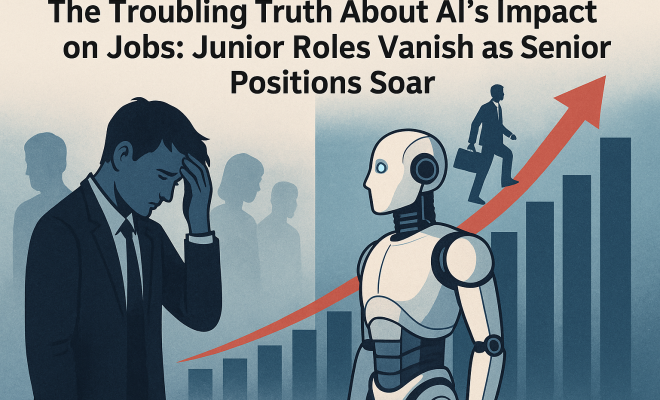
The Troubling Truth About AI’s Impact on Jobs: Junior Roles Vanish as Senior Positions Soar
Alright, let’s talk about artificial intelligence. For years, we’ve heard the buzz – AI is coming, it’s going to change everything, it’s either going to usher in a new era of prosperity or steal all our jobs. Well, a groundbreaking new study is finally giving us some concrete data, and the picture it paints, particularly for those just starting their careers, is quite frankly, concerning. This isn’t just theory anymore; we’re seeing real, measurable shifts in the global labor market, and these AI hiring trends are something every educator, every student, and every professional needs to understand.
The research, conducted by Bharat Chandar of Stanford University and Bouke Klein Teeselink of King’s College London, and released on September 21, 2026, offers a deep dive into the hiring patterns of companies that have embraced AI. They didn’t just look at a handful of companies; we’re talking about an analysis of 1.25 billion job postings and 154 million employment records across 41 countries. That’s an absolutely massive dataset, covering a period from January 2021 to March 2026. What they found reveals a significant, and perhaps unwelcome, truth about how AI adoption is reshaping the workforce.
The AI Paradox: More Jobs Overall, But Who Benefits?
On the surface, the news might sound good: AI adoption generally leads to an increase in overall hiring. That’s a point many AI proponents have emphasized, arguing that new technologies create more jobs than they destroy. And to a certain extent, this study supports that claim. Companies investing in AI are expanding their workforces. But here’s where the nuance, and the concern, comes in: these gains aren’t evenly distributed. Not by a long shot.
The research clearly indicates a disproportionate favoring of senior employees. Their positions at AI-adopting companies rose by a substantial 6.7% over the five-year study period. Think about that for a moment – nearly a 7% increase in senior roles directly attributable to AI integration. This suggests that AI isn’t just augmenting existing senior work; it’s creating entirely new opportunities and elevating the demand for experienced leadership and specialized expertise.
Now, compare that to the other end of the spectrum. While senior roles surged, junior employment at these same companies actually declined by 3% during the identical period. This isn’t a small dip; it’s a measurable reduction in entry-level positions. Consequently, the share of junior workers within these AI-driven organizations saw a 1.9 percentage point decrease. This finding is particularly striking because it challenges the conventional wisdom that technological advancements simply create new types of jobs across all levels. Instead, it seems AI is acting as a kind of filter, sifting out the need for certain types of junior labor while amplifying the demand for high-level strategic and technical talent.
Understanding the ‘Labor Saving’ vs. ‘Labor Expanding’ Dynamic
Chandar and Teeselink’s study offers a critical insight into this discrepancy, characterizing AI as “labor saving for junior workers and labor expanding for seniors in exposed occupations.” What does that really mean for the average person trying to break into a career or move up the ladder?
For junior workers, especially those in roles that involve repetitive tasks, data entry, basic analysis, or support functions, AI is proving to be incredibly efficient. These are often the tasks that serve as stepping stones into a career, allowing individuals to learn the ropes, build foundational skills, and prove their capabilities. But if AI can automate or significantly streamline these functions, the need for human hands to perform them diminishes. This isn’t about AI replacing humans wholesale; it’s about AI absorbing the more rudimentary, process-driven aspects of a job, leaving less room for entry-level professionals to gain initial experience.
On the flip side, senior workers, particularly those in “exposed occupations”—meaning roles that interact directly with or are heavily influenced by AI technologies—are finding their expertise in higher demand. These are the individuals who design, implement, manage, interpret, and strategize around AI systems. They’re the ones making sense of the data AI generates, translating AI insights into business decisions, and overseeing the integration of complex AI solutions. Their roles aren’t being replaced; they’re being amplified and made more critical. The AI hiring trends here are clear: experience and advanced skills are at a premium.
The Digital Divide: How Digitized Economies Are Impacted
Another fascinating layer to this research is how the effects of AI adoption are amplified in more digitized economies. It makes sense, doesn’t it? Countries and regions with higher levels of digital infrastructure, greater technological penetration, and a more tech-savvy workforce are naturally going to experience these shifts more intensely. If a company is already operating in a highly digitized environment, integrating AI is a more seamless, and therefore more impactful, process.
In these economies, the ability of AI to automate junior-level tasks is accelerated. Companies can deploy AI solutions more readily, achieving efficiency gains faster. This means the pressure on junior roles to evolve or diminish is even greater. Conversely, the demand for senior professionals capable of navigating these advanced digital landscapes, particularly with AI at the helm, becomes even more acute. They’re not just managing people and processes; they’re managing highly sophisticated technological ecosystems. This creates a kind of feedback loop: more digitization enables more effective AI adoption, which in turn exacerbates the disparity in hiring for junior versus senior roles. The AI hiring trends are not uniform; they’re heavily influenced by a nation’s digital readiness.
The Looming Skill Gap and Edtech’s Crucial Role
So, we have a clear problem emerging: a growing employability gap for junior professionals. If entry-level positions are shrinking, how do people gain the experience needed to eventually become senior-level contributors? This is where the world of education technology, or Edtech, steps into a truly critical role. The traditional pathways into careers are being disrupted, and Edtech platforms are uniquely positioned to offer solutions. (See: AI's impact on the job market.)
We need specialized upskilling and reskilling programs, and we need them now. These aren’t just about teaching basic coding or software use. We’re talking about advanced AI competencies: machine learning principles, data science, AI ethics, prompt engineering, AI system integration, and understanding how AI impacts business strategy. But it’s not just about technical skills. It’s also about transferable skills—critical thinking, problem-solving, adaptability, creativity, and complex communication—all of which become even more vital when working alongside intelligent machines. The AI hiring trends demand a new kind of preparation.
For Edtech companies, this isn’t just a social responsibility; it’s a massive market opportunity. The niche of AI training and career development is poised to become incredibly lucrative, with high Cost Per Click (CPC) values reflecting the immense demand for these specialized skills. Platforms that can effectively bridge this gap, providing high-quality, accessible, and relevant training, will not only do good but also do well. For more context, see AI Certifications for Career Success.
Redefining ‘Entry-Level’ in an AI-Driven World
If AI is absorbing many of the tasks traditionally associated with junior roles, then what does an ‘entry-level’ position even look like in the future? This is a question we, as educators and industry leaders, absolutely must grapple with. It’s no longer enough to expect graduates to walk into roles where they learn by doing basic, repetitive tasks. Those tasks are increasingly being handled by algorithms.
Instead, entry-level roles might need to be redefined to focus on skills that are harder for AI to replicate: creativity, critical problem-solving that requires human intuition, understanding complex human needs, ethical considerations, and collaborative work that leverages AI as a tool rather than being replaced by it. Think of roles that involve human-AI collaboration from day one, where junior professionals are trained to work with AI to achieve outcomes, rather than performing tasks that AI could do independently. This necessitates a fundamental shift in curriculum design and career readiness programs.
Perhaps an entry-level position now requires a foundational understanding of AI tools and methodologies, even if the primary role isn’t strictly AI development. It might involve data interpretation, user experience design for AI interfaces, or even ethical AI auditing. The AI hiring trends are forcing us to rethink our entire pipeline.
The Imperative for Lifelong Learning and Adaptability
This study underscores a truth that many of us in education have been advocating for years: the concept of a static career path is dead. Lifelong learning isn’t a nice-to-have; it’s an absolute necessity. For junior professionals, in particular, the message is stark: continuous upskilling and reskilling are no longer optional extras; they are the bedrock of career resilience.
Individuals entering the workforce today must cultivate an ‘adaptability mindset.’ They need to anticipate that their skill sets will need constant refreshing, that new technologies will emerge, and that the demands of their roles will evolve rapidly. This means actively seeking out learning opportunities, whether through formal Edtech programs, industry certifications, or self-directed learning. Companies also bear a responsibility here, investing in their employees’ continuous development to ensure their workforce remains competitive and relevant in the face of these rapid AI hiring trends.
Imagine a scenario where every professional, regardless of their current role, has a personalized learning plan, leveraging AI-powered tutors like Entelechy.app, to stay ahead of the curve. This isn’t science fiction; it’s becoming a necessity. The ability to pivot, to learn new tools, and to apply existing knowledge in novel ways will be the hallmarks of successful careers in the AI era.
Policy Implications and the Role of Government
The findings from Chandar and Teeselink aren’t just for individuals and companies; they have significant policy implications for governments worldwide. If AI adoption is leading to a widening gap between senior and junior employment, what responsibilities do states have to mitigate potential societal disruption?
Governments might need to consider investing more heavily in public education programs that focus on AI literacy and advanced technical skills from an earlier age. They could also explore subsidies or incentives for companies that invest in upskilling their junior workforce. Furthermore, social safety nets and unemployment support systems may need to be re-evaluated to account for potential structural unemployment caused by AI automation of entry-level tasks. This isn’t about halting progress; it’s about ensuring a just transition for all workers.
There’s also a role for international cooperation. Since this study spans 41 countries, it’s clear that these AI hiring trends are global. Sharing best practices, collaborating on curriculum development, and creating standardized certifications for AI-related skills could help countries collectively address this challenge more effectively. We can’t afford to let this become a race to the bottom for junior workers.
What This Means for Educators and Institutions
As an educator who’s spent years in K-12 and university settings, this research hits home. It’s a wake-up call for every school, college, and university. Our curricula must evolve faster than ever before. We can’t keep preparing students for a world that no longer exists. (See: AI in occupational health.)
We need to integrate AI literacy across all disciplines, not just computer science. Every student, regardless of their major, should understand how AI works, its capabilities, its limitations, and its ethical implications. We need to foster critical thinking and problem-solving skills that allow students to thrive in ambiguous, rapidly changing environments. Project-based learning, interdisciplinary studies, and real-world problem-solving, all facilitated by tools like Pedagogue.app for collaboration, become even more vital.
Furthermore, institutions need to build stronger bridges with industry to understand the evolving skill demands in real-time. This means more internships, co-op programs, and industry partnerships that expose students to the realities of AI-driven workplaces. The P-20 Education Careers platform, for instance, can play a crucial role in connecting talent with these evolving opportunities. It’s about proactive preparation, not reactive adaptation. For more context, see AI Ban for Young Students.
The Global Impact: Comparing AI Adoption Rates
The fact that this study covers 41 countries gives us a fantastic opportunity to look at regional differences. While the overall trend of favoring senior roles holds globally, the intensity of this shift isn’t uniform. For example, highly developed economies like the United States, Germany, and Japan, which often have higher rates of digital transformation and significant investment in AI research and development, might see these trends play out more aggressively. In these nations, where companies are quick to adopt cutting-edge AI, the demand for senior AI architects, data scientists, and ethical AI officers would spike, while the automation of routine junior tasks would also accelerate.
Contrast this with emerging economies or those still building their digital infrastructure. Here, the adoption of AI might be slower, or focused on different applications, perhaps initially on optimizing existing processes rather than creating entirely new ones. This could mean a delayed or less pronounced impact on junior roles, offering a window of opportunity for these countries to proactively upskill their workforce. However, it also means they risk falling behind if they don’t prepare. The varying speeds of AI integration mean that while the challenges are global, the specific strategies for addressing them will need local tailoring. Understanding these nuances is key for both policymakers and educators.
Ethical Considerations in AI-Driven Hiring
Beyond the economic shifts, we absolutely have to talk about the ethical implications of AI in hiring. When AI is making or influencing hiring decisions, especially for junior roles, how do we ensure fairness and prevent bias? Algorithms are only as unbiased as the data they’re trained on. If historical hiring data contains biases against certain demographics, AI systems could inadvertently perpetuate or even amplify those biases, making it even harder for diverse candidates to secure entry-level positions. This isn’t just a hypothetical concern; it’s a documented problem with AI tools in various sectors.
We need robust ethical frameworks and regulatory oversight to ensure AI hiring tools are transparent, accountable, and free from discrimination. Companies adopting AI in their recruitment processes have a responsibility to audit their systems regularly for bias and to implement safeguards. As future professionals, junior workers need to be aware of these issues and be prepared to advocate for fair and ethical AI practices. This means teaching AI ethics in schools isn’t just for computer science majors; it’s for everyone, because AI touches every part of our lives, including who gets a job and who doesn’t.
The Role of Soft Skills in an AI-Augmented Workforce
It’s easy to get caught up in the technical skills needed for an AI world – coding, data science, machine learning. But what this study implicitly highlights is the increasing importance of what we often call “soft skills.” If AI is handling the repetitive, predictable tasks, then the uniquely human skills become paramount. Think about it: creativity, emotional intelligence, complex communication, collaboration, adaptability, and critical thinking that goes beyond data analysis to include ethical and societal implications. These are the skills that AI struggles to replicate.
For junior professionals, cultivating these soft skills is no longer a bonus; it’s a core competency. An entry-level employee who can effectively communicate complex AI insights to a non-technical audience, or who can creatively apply AI tools to solve novel problems, will be far more valuable than someone who can simply execute a predefined task. Educators need to prioritize teaching these skills, integrating them into every aspect of the curriculum, from elementary school right through higher education. We’re not just preparing students for jobs; we’re preparing them to be effective, adaptable humans in an AI-powered world.
Frequently Asked Questions About AI Hiring Trends
What exactly are AI hiring trends?
AI hiring trends refer to the observable shifts in recruitment and employment patterns as companies adopt artificial intelligence technologies. This includes changes in the types of roles being created or eliminated, the skills employers prioritize, and the demographic distribution of new hires (e.g., favoring senior vs. junior employees).
Why are junior roles declining in AI-adopting companies?
Junior roles often involve repetitive, data-intensive, or process-driven tasks that AI is exceptionally good at automating or streamlining. As AI tools become more sophisticated, they can perform these entry-level functions more efficiently, reducing the need for human input in those specific areas. This means fewer traditional entry-level positions are available for newcomers to gain experience. For more context, see Hidden Cost of AI Bans in Schools. (See: Research on AI and employment trends.)
How can junior professionals prepare for this AI-driven job market?
Preparation involves a multi-pronged approach: focusing on continuous learning (upskilling/reskilling) in AI-related competencies like prompt engineering, data interpretation, and AI ethics; developing strong human-centric skills such as creativity, critical thinking, and communication; and being adaptable to new technologies and evolving job descriptions. Platforms like Entelechy.app can help with personalized learning.
Are all industries affected by these AI hiring trends equally?
No, the impact varies. Industries heavily reliant on data processing, customer service, or repetitive administrative tasks (e.g., finance, retail, certain manufacturing sectors) are likely to feel these shifts more acutely. Creative industries or those requiring high levels of human empathy and complex problem-solving might see different types of AI integration, perhaps augmenting rather than replacing roles.
What role does Edtech play in addressing the skill gap?
Edtech is crucial. It provides accessible, scalable, and often personalized learning solutions for individuals to acquire the new skills demanded by AI. This includes online courses, certifications, virtual labs, and AI-powered tutoring platforms that can help bridge the gap between traditional education and the rapidly evolving needs of the job market. Tools like The Edvocate and The Tech Edvocate can keep you informed on these developments.
Should governments intervene in AI hiring trends?
Many argue that governments have a significant role. This could involve investing in public education and vocational training programs focused on AI literacy, creating incentives for companies to invest in employee upskilling, and developing robust regulatory frameworks to ensure ethical AI deployment and prevent discriminatory hiring practices. International cooperation is also key given the global nature of these trends.
Looking Ahead: Navigating the AI-Driven Future of Work
The study by Chandar and Teeselink is a powerful piece of research, offering a clear, data-driven look at how AI is already reshaping global employment. It confirms what many have suspected: AI is a force multiplier for experienced professionals, but a disruptor for those at the beginning of their careers. The AI hiring trends are not just statistics; they represent real people’s livelihoods and futures.
This isn’t a doomsday scenario, but it is a call to action. For individuals, it means embracing lifelong learning and cultivating advanced skills. For Edtech companies, it’s an unprecedented opportunity to provide crucial training and development. For educators, it’s a mandate to innovate our teaching methods and curricula. And for governments, it’s a challenge to create policies that ensure equitable access to the benefits of AI.
The future of work, driven by AI, won’t be about humans versus machines. It will be about humans who can effectively collaborate with and leverage machines, and those who cannot. Our collective task now is to ensure that as many people as possible are equipped to be in the former category, transforming these troubling AI hiring trends into opportunities for growth and innovation for everyone.
Trending Now
Frequently Asked Questions
How is AI impacting job opportunities for entry-level positions?
AI is significantly affecting entry-level job opportunities, with a troubling decline in junior roles as companies increasingly favor senior positions. A recent study indicates that while overall hiring may increase due to AI, the benefits are disproportionately skewed towards experienced workers.
Are more jobs being created because of AI?
Yes, AI adoption generally leads to an increase in overall hiring. However, this growth is not evenly distributed, with a notable rise in senior roles compared to a decline in junior positions, highlighting the complexities of AI's impact on the labor market.
What did the study on AI and job trends find?
The study, which analyzed 1.25 billion job postings and 154 million employment records, found that while AI adoption increases overall hiring, it disproportionately benefits senior employees, with their roles increasing by 6.7% over the study period.
Who benefits the most from AI in the workplace?
The benefits of AI in the workplace are primarily seen by senior employees, whose positions have increased significantly. In contrast, junior roles are vanishing, raising concerns about the future job landscape for those just starting their careers.
What should educators and students know about AI's impact on jobs?
Educators and students should be aware that AI is reshaping the job market, particularly disadvantaging entry-level positions. Understanding these trends is crucial for preparing future professionals to navigate a workforce increasingly dominated by AI.
Agree or disagree? Drop a comment and tell us what you think.