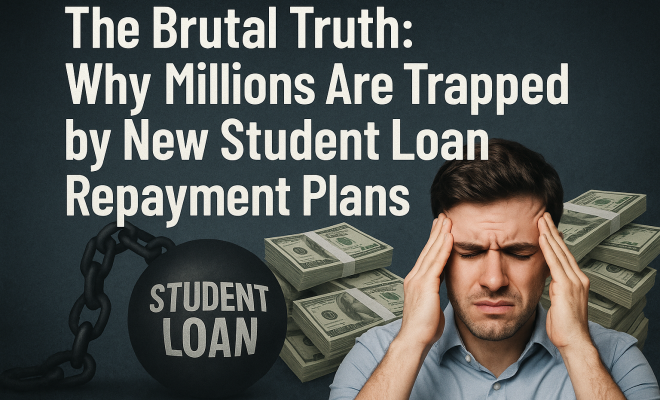
The Brutal Truth: Why Millions Are Trapped by New Student Loan Repayment Plans
If you’re one of the millions of students or former students grappling with federal loan repayment, you’re likely feeling a mix of frustration, confusion, and maybe even a little panic. It’s not just you. We’re in a moment of unprecedented upheaval in the world of student finance, and it’s hitting people hard. The federal government’s recent changes, particularly the termination of the popular SAVE repayment plan and the rollout of new rules under the One Big Beautiful Bill Act, have thrown a wrench into the financial plans of countless borrowers. This isn’t just about paying back a loan; for many, it’s about keeping a roof over their head, food on the table, and the lights on. It’s a crisis with real, human consequences.
The situation has been brewing for a while, but it reached a boiling point over the summer semester of 2026, with federal student loan disbursements facing significant, widespread delays. Imagine planning your life, your budget, and your very ability to stay in college around a certain expectation, only to have the rug pulled out from under you. Students have reported fears of eviction and utility cut-offs – dire consequences that highlight just how critical these funds are. And if you think that’s bad, experts are worried this chaos will bleed into the crucial fall semester, potentially making housing and food insecurity even worse for the nearly 60% of students already struggling with these basic needs. This isn’t just an administrative hiccup; it’s a systemic failure with devastating effects. Understanding your student loan repayment plans compared to what’s available now, or what was available just yesterday, is more critical than ever.
1. The Unraveling of the SAVE Plan: A Sudden Shift
Let’s start with what was, for many, a lifeline: the SAVE (Saving on a Valuable Education) repayment plan. This plan, which gained significant traction, offered a glimmer of hope for borrowers struggling to make ends meet. It was designed to make monthly payments more affordable by basing them on a borrower’s discretionary income and family size, often resulting in lower, sometimes even $0, monthly payments for those with lower incomes. The idea was to prevent default and provide a sustainable path to loan forgiveness.
However, the federal government has made a stunning reversal. By the end of September 2026, the SAVE plan as we knew it will be no more. This isn’t a gradual phase-out; it’s a hard stop. For millions of borrowers who structured their financial lives around the affordability of SAVE, this is nothing short of a catastrophe. They will be forced onto more expensive standard repayment plans, often without adequate warning or preparation. The suddenness of this change is what truly sets it apart, leaving little room for adjustment and causing immense stress.
2. Forced Onto Standard Repayment Plans: The New Reality
With the SAVE plan gone, a huge chunk of borrowers will find themselves shunted onto standard repayment options. What does that actually mean? Well, standard repayment plans are typically designed to pay off your loan in 10 years (or 30 years for consolidated loans), with fixed monthly payments. While this sounds straightforward, the payments are often significantly higher than those offered by income-driven plans like SAVE, especially for borrowers with lower incomes or high loan balances.
Think about it: if your previous payment was $50 under SAVE, and now you’re facing a $300 or $400 payment under a standard plan, that’s a massive jump. For many, this isn’t just an inconvenience; it’s an impossibility. It means making impossible choices between paying your student loan and covering essential living expenses. It’s a stark reminder that when we talk about student loan repayment plans compared, the differences aren’t just theoretical; they’re deeply impactful.
3. The One Big Beautiful Bill Act: Unintended Consequences
Adding another layer of complexity is the One Big Beautiful Bill Act, which went into effect on July 1, 2026. While the name might sound reassuring, its implementation has been anything but. This new legislation necessitated major overhauls to college financial aid systems across the country. And, as is often the case with massive bureaucratic shifts, the transition has been anything but smooth.
These systemic updates are the direct cause of the significant delays in federal student loan disbursements we saw over the summer. Colleges and their financial aid departments, already stretched thin, have been scrambling to adapt to the new rules, leading to processing backlogs and students simply not receiving their funds on time. This isn’t just about tuition; these disbursements often cover living expenses, books, and other crucial costs. When they’re delayed, students are left in limbo, facing potential eviction, utility shut-offs, and an inability to afford basic necessities. It’s a cascading failure that highlights the fragility of many students’ financial situations.
4. The PSLF Buyback Blocker: A Crushing Blow for Public Servants
As if the changes to repayment plans weren’t enough, the Education Department has also decided to block Public Service Loan Forgiveness (PSLF) Buyback benefits for those enrolled in new repayment options. This is a particularly brutal blow for individuals who have dedicated their careers to public service – teachers, nurses, social workers, government employees – often earning modest salaries while serving their communities.
PSLF was designed to provide a pathway to forgiveness after 10 years of qualifying payments for these essential workers. The ‘Buyback’ aspect would have allowed borrowers to count past periods of non-qualifying payments towards PSLF if they made up the difference. Blocking this option removes a crucial safety net and disincentivizes public service, leaving many feeling betrayed. It’s a policy decision that seems to disregard the invaluable contributions of these individuals, and it makes comparing student loan repayment plans even more disheartening for this specific group.
5. The Looming Fall Semester Crisis: A Worsening Outlook
The summer semester delays were bad enough, but experts are genuinely concerned that these issues will persist, and even worsen, as we head into the crucial fall semester. The sheer volume of students enrolling, combined with the continued struggles of financial aid systems to fully implement the new federal rules, creates a perfect storm for continued chaos. (See: U.S. Department of Education.)
This isn’t just about administrative headaches; it has profound human implications. When nearly 60% of students already face housing and food insecurity, any disruption to their financial aid can push them over the edge. We’re talking about students dropping out, becoming homeless, or going hungry – not because they’re failing academically, but because a broken system has failed them. The ripple effect of these delays will be felt across campuses and communities nationwide, exacerbating existing inequalities and creating new hardships.
6. Navigating Your Student Loan Repayment Plans Compared: What Are Your Options?
Given this tumultuous landscape, what’s a borrower to do? It’s a tough question, and the answers aren’t always clear-cut. However, understanding the remaining student loan repayment plans compared to your current situation is the first step toward making an informed decision. While SAVE is gone, other income-driven repayment (IDR) plans still exist, though they may not offer the same level of affordability. For more context, see Millions Face Repayment Chaos: Your Student Loan Plan Is Disappearing.
You might consider plans like Income-Based Repayment (IBR), Pay As You Earn (PAYE), or Income-Contingent Repayment (ICR). Each has different formulas for calculating monthly payments, different forgiveness timelines, and different eligibility requirements. It’s crucial to compare these carefully against the standard 10-year repayment plan to see which, if any, offers a more manageable payment for your specific financial situation. Don’t assume anything; do the math, or better yet, get help doing it.
7. Consolidation and Refinancing: A Double-Edged Sword
For some, consolidation or refinancing might seem like a viable path. Federal loan consolidation combines multiple federal loans into one, potentially simplifying payments and offering access to different repayment plans. However, it’s important to understand that consolidating federal loans doesn’t typically lower your interest rate; it averages them out. More importantly, if you consolidate, you might reset your payment count for any potential loan forgiveness programs, which could be a significant drawback depending on your goals.
Refinancing, on the other hand, involves taking out a new loan from a private lender to pay off your existing federal or private loans. This can sometimes result in a lower interest rate, especially if you have excellent credit. However, refinancing federal loans into private ones means giving up all federal protections, including access to income-driven repayment plans, deferment, forbearance options, and any future federal forgiveness programs. This is a significant trade-off, and it’s one you should weigh very carefully, especially in this unpredictable environment. When you’re looking at student loan repayment plans compared, the long-term implications of these choices are paramount.
8. The Importance of Communication and Documentation: Protect Yourself
In times of uncertainty, diligent communication and meticulous documentation are your best friends. If you’re experiencing delays in disbursements or have questions about your repayment options, contact your college’s financial aid office and your loan servicer immediately. Don’t wait. Keep detailed records of every conversation: who you spoke to, the date and time, what was discussed, and any reference numbers provided. Save all emails and letters. This paper trail can be invaluable if you need to dispute an error or prove you’ve tried to resolve an issue.
The system is clearly under strain, and mistakes are inevitable. It’s up to you to protect your interests. Proactive communication, even if it feels like you’re yelling into the void, is better than assuming things will sort themselves out. They might not, and you could be left footing an even bigger bill.
9. Advocacy and Support Networks: You’re Not Alone
While the individual burden of these changes is immense, it’s crucial to remember that you are not alone. Millions of students and borrowers are facing similar challenges. This collective struggle creates an opportunity for advocacy. Reach out to student advocacy groups, non-profit organizations focused on student debt, and even your elected officials. Share your story. The more voices that speak up, the greater the pressure on policymakers to address these systemic issues.
Furthermore, seek out support networks. Connect with other students or borrowers who are going through similar experiences. Sometimes, simply knowing you’re not the only one struggling can make a huge difference. These communities can also be a source of shared information, tips, and strategies for navigating this complex landscape. The Education Department’s decisions affect us all, and collective action is often the most powerful way to drive change.
10. Considering Professional Guidance: When to Seek Help
Given the complexity and the high stakes involved, sometimes the best course of action is to seek professional guidance. Student loan lawyers or accredited financial counselors specializing in student debt can provide personalized advice tailored to your unique situation. They can help you understand all your student loan repayment plans compared, analyze your income and debt, and identify the best path forward. This could include helping you navigate the remaining income-driven repayment options, assessing the pros and cons of refinancing, or even assisting with disputes with your loan servicer.
While there might be a cost associated with these services, consider it an investment in your financial future. The potential savings from choosing the right repayment plan or avoiding costly mistakes could far outweigh the initial expense. Just be sure to choose reputable professionals and be wary of any service that promises quick fixes or charges exorbitant fees upfront. Your financial well-being is too important to leave to chance in these turbulent times.
11. Understanding the Remaining Income-Driven Repayment (IDR) Plans
Let’s dive a bit deeper into the income-driven repayment plans that are still on the table. While SAVE offered the most generous terms for many, particularly those with lower incomes, it’s not the only IDR game in town. Understanding the nuances of each can help you pick the least painful option, especially now that SAVE is off the table.
Income-Based Repayment (IBR)
IBR is one of the older IDR plans. Under IBR, your monthly payment is generally 10% or 15% of your discretionary income, depending on when you took out your loans. The catch here is that your payment will never be more than what you’d pay under the 10-year Standard Repayment Plan. This plan offers forgiveness of any remaining balance after 20 or 25 years of payments, again, depending on when you borrowed. For new borrowers (those who took out loans on or after July 1, 2014), it’s 10% of discretionary income and 20 years to forgiveness. For older loans, it’s 15% and 25 years. This “never more than standard” cap can be a double-edged sword; it protects you from incredibly high payments, but if your income rises significantly, your payments could still be quite substantial. (See: Food insecurity among students.)
Pay As You Earn (PAYE)
PAYE typically sets your monthly payment at 10% of your discretionary income, but it also caps your payment at the amount you’d pay under the 10-year Standard Repayment Plan. The forgiveness timeline for PAYE is 20 years. This plan is often seen as a slightly more favorable version of IBR for some borrowers because the percentage of discretionary income is always 10%, regardless of when you borrowed. However, eligibility for PAYE is restricted; you generally need to be a “new borrower,” meaning you had no outstanding federal student loans when you received a new loan on or after October 1, 2007, and you must have received a new direct loan on or after October 1, 2011. This makes it unavailable to a significant portion of borrowers. There’s a fuller look at costs of the Save Plan.
Income-Contingent Repayment (ICR)
ICR is the oldest income-driven plan. Your monthly payment under ICR will be the lesser of 20% of your discretionary income or what you’d pay on a fixed 12-year repayment plan, adjusted according to your income. Any remaining balance is forgiven after 25 years. ICR is generally less generous than IBR or PAYE because it uses a higher percentage of your discretionary income for calculations. However, it’s the only IDR plan available to parents with PLUS loans who haven’t consolidated them into a Direct Consolidation Loan. So, while it might not be the most affordable for everyone, it serves a specific niche. For more context, see 72% of Gen Z Still Financially Dependent on Parents — Here’s Why It’s a Crisis.
When comparing these plans, you really need to look at your specific income, family size, and total loan balance. The definition of “discretionary income” also changes slightly between plans, which impacts your payment calculation. It’s a puzzle, and it requires careful attention to detail.
12. The Broader Economic Impact of Student Loan Instability
The turmoil in student loan repayment isn’t just an individual crisis; it has significant ripple effects across the broader economy. When millions of borrowers face increased monthly payments, that’s less money they have to spend on other goods and services. This can dampen consumer spending, which is a major driver of economic growth.
Think about it: if someone suddenly has to pay an extra $200-$300 a month on their student loans, that’s $200-$300 less for rent, groceries, car payments, or even starting a family. This reduction in disposable income can slow down housing markets, hurt small businesses, and even affect retirement savings. Young adults, often burdened by student debt, are already delaying major life milestones like buying a home, getting married, or having children. The current instability only exacerbates these trends, creating a generation that feels perpetually behind financially.
Moreover, the stress and uncertainty surrounding student loans can impact mental health and productivity. Students who are worried about eviction or affording food can’t focus effectively on their studies, potentially leading to lower academic performance and even dropping out. This loss of human capital is a long-term drag on the economy. The current situation isn’t just about loan payments; it’s about the economic health and social well-being of the nation.
13. Expert Perspectives: What Are Policy Makers Missing?
From my perspective, having spent years in education and observing these policies firsthand, the biggest miss from policymakers is a fundamental understanding of the daily realities of students and recent graduates. There’s a persistent disconnect between the bureaucratic mechanisms of federal aid and the lived experiences of borrowers. Related reading: millions missing loan forgiveness.
The sudden termination of the SAVE plan, for instance, feels like a decision made in a vacuum, without fully grasping the reliance millions had placed on it. It’s not just a program; it was a financial anchor for many. When you pull that anchor without adequate warning or a viable alternative, you create chaos. The ‘One Big Beautiful Bill Act’ is another example. While its intentions might have been good, the implementation clearly lacked foresight regarding the capacity of financial aid offices and the potential for technological glitches.
What’s missing is a human-centered approach to policy-making. We need policies that are stable, predictable, and genuinely supportive of educational attainment and economic mobility, not ones that create sudden cliffs and exacerbate financial precarity. There’s also a lack of accountability when these systemic failures occur. Who is held responsible for students facing eviction because their aid was delayed? These are not abstract problems; they are concrete failures that demand concrete solutions and a commitment to protecting the most vulnerable.
14. The Role of Forbearance and Deferment in the Current Climate
In this uncertain environment, many borrowers might be tempted to consider forbearance or deferment. These options allow you to temporarily postpone or reduce your loan payments, but it’s crucial to understand their implications. (See: New York Times on student loan changes.)
Forbearance
Forbearance lets you stop making payments or reduce your payments for up to 12 months at a time. The big downside? Interest usually continues to accrue on all loan types during forbearance, which means your loan balance can grow significantly. This can make your overall repayment more expensive in the long run. Forbearance is usually granted for situations like financial hardship, medical expenses, or changes in employment.
Deferment
Deferment also allows you to temporarily postpone payments. The key difference from forbearance is that interest typically does NOT accrue on subsidized federal loans during deferment. For unsubsidized loans, PLUS loans, and consolidated loans, interest still accrues. Common reasons for deferment include enrollment in school, unemployment, economic hardship, or military service. Like forbearance, it’s usually granted for a limited time.
While both can offer temporary relief, they shouldn’t be seen as long-term solutions. They are more like emergency brakes. If you can afford to make payments, even small ones, it’s generally better to do so to avoid interest capitalization and a ballooning loan balance. Always speak with your loan servicer to understand the specific terms and consequences before opting for either forbearance or deferment. In the context of student loan repayment plans compared, these are temporary pauses, not permanent solutions.
Frequently Asked Questions About Student Loan Repayment Changes
Q1: My SAVE plan payments were $0. What happens now that it’s gone?
A1: This is a major concern for millions. With the SAVE plan ending, you will likely be transitioned to a standard repayment plan. This means your monthly payments will be calculated based on a 10-year repayment schedule (or 30 years for consolidated loans) at a fixed rate, regardless of your income. For many, this will result in significantly higher payments, potentially moving from $0 to hundreds of dollars a month. It’s critical to contact your loan servicer immediately to understand your new payment amount and explore if you qualify for any other income-driven repayment plans like IBR, PAYE, or ICR, though they may not offer the same affordability as SAVE.
Q2: Will the PSLF Buyback benefit ever be reinstated?
A2: As of now, the Education Department has stated that PSLF Buyback benefits are blocked for those enrolled in new repayment options. While advocacy groups are pushing for its reinstatement, there’s no guarantee it will happen. This means if you had periods of non-qualifying payments that you hoped to ‘buy back’ to count towards your 120 PSLF payments, that option is currently unavailable if you are on a newly selected repayment plan. Public servants need to stay informed through official Department of Education announcements and credible student advocacy organizations.
Q3: What should I do if my federal student loan disbursement is delayed for the fall semester?
A3: If your financial aid disbursement is delayed, first contact your college’s financial aid office. They are the primary point of contact for understanding the status of your aid and can often provide estimates or explanations for delays caused by the One Big Beautiful Bill Act. Document every conversation – who you spoke to, the date, and what was discussed. If your basic needs are at risk (housing, food), inform your financial aid office of your situation and ask about emergency aid, campus resources, or local support programs. Don’t wait; be proactive.
Q4: Is refinancing federal loans into private loans a good idea right now?
A4: Refinancing federal loans into private loans can sometimes offer a lower interest rate if you have excellent credit. However, it’s generally not recommended in this unstable environment, especially if you anticipate needing federal protections. When you refinance federal loans into private ones, you permanently lose access to all federal benefits, including income-driven repayment plans, deferment, forbearance, and any potential federal loan forgiveness programs (like PSLF). Given the ongoing changes and uncertainty, retaining federal protections is often more valuable than a slightly lower interest rate from a private lender. Weigh this decision very carefully.
Q5: How do I compare the different income-driven repayment plans effectively?
A5: Comparing IDR plans can be complex because eligibility, discretionary income calculations, and forgiveness timelines differ. The best way is to use the Loan Simulator tool on the Federal Student Aid website (StudentAid.gov). This tool allows you to input your specific loan information, income, and family size to see estimated payments under each available plan. You can also contact your loan servicer, but be prepared with specific questions and take detailed notes. For personalized, unbiased advice, consider consulting with a non-profit student loan counselor or a qualified financial advisor specializing in student debt.
Trending Now
- read the full story
- Unbelievable: The True Cost of Raising a Child Will Absolutely Devour Your Savings
- our breakdown of shocking: young children are flooding ers in mental health crisis — here’s why
- this guide on jaw-dropping: ai’s quiet takeover of law school — are you ready?
- read the full story
Frequently Asked Questions
What happened to the SAVE student loan repayment plan?
The SAVE (Saving on a Valuable Education) repayment plan has been terminated, causing significant distress among borrowers who relied on it for manageable repayment options. This sudden shift has left many students and former students grappling with their financial obligations as new repayment rules are introduced under the One Big Beautiful Bill Act.
How are new student loan repayment plans affecting borrowers?
New student loan repayment plans have created confusion and frustration among borrowers. With recent changes leading to delays in federal student loan disbursements, many are facing fears of eviction and utility cut-offs, highlighting the severe impact on their daily lives and financial stability.
What are the consequences of delays in federal student loan disbursements?
Delays in federal student loan disbursements have resulted in severe financial consequences for students, including fears of eviction and inability to pay for basic necessities like food and utilities. These delays are exacerbating existing insecurity for nearly 60% of students who are already struggling with basic needs.
Why is understanding student loan repayment plans more critical now?
Understanding student loan repayment plans is crucial now due to the recent changes and the termination of the SAVE plan. Borrowers need to navigate new options and prepare for potential financial instability, as the landscape of federal student loans has shifted dramatically, impacting their repayment strategies.
What should borrowers do amid the changes to student loan repayment plans?
Borrowers should stay informed about the latest changes to student loan repayment plans and explore available options under new regulations. Seeking advice from financial aid offices or student loan counselors can help them navigate this tumultuous landscape and develop effective repayment strategies.
What's your take on this? Share your thoughts in the comments below — we read every one.