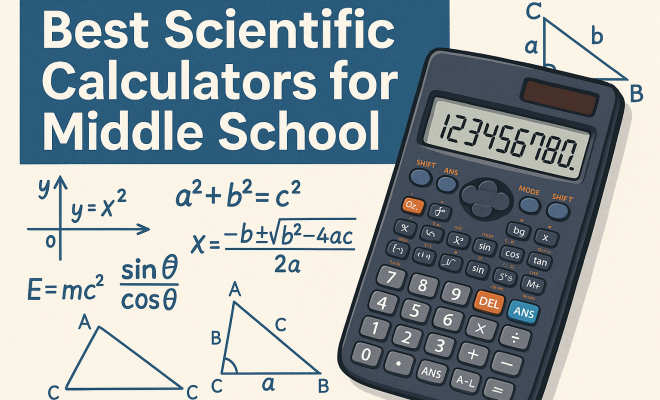
Best Scientific Calculators for Middle School
“`html
As students transition into middle school, they encounter more complex math concepts that require powerful tools to aid their learning. Scientific calculators become essential. They not only simplify calculations but also enhance understanding of mathematical principles. In this article, we will explore the best scientific calculators for middle school, detailing their features, pros and cons, and why they matter in a student’s educational journey.
1. Texas Instruments TI-30XS Multiview: Versatility Meets Clarity
The Texas Instruments TI-30XS Multiview stands out as one of the best scientific calculators for middle school students. With its ability to display multiple calculations at once, students can view the steps in their calculations, making it easier to understand the process. The multi-line display helps prevent errors that often occur when students have to scroll back through calculations.
This calculator includes a variety of functions, from basic arithmetic to advanced scientific calculations, making it a versatile choice for students. Additionally, its lightweight design and long battery life mean it’s perfect for daily school use. Despite its features, it remains user-friendly, which is crucial for middle schoolers starting to grasp more challenging math concepts.
2. Casio fx-300ES PLUS: The Eco-Friendly Option
Another contender for the title of best scientific calculators for middle school is the Casio fx-300ES PLUS. This model is particularly known for its eco-friendly solar power option, ensuring that it can be used without frequently changing batteries. It also features a natural textbook display, allowing students to input expressions as they would write them on paper, which can significantly aid in comprehension.
The calculator has 252 functions, including fractions, statistics, and trigonometry, making it suitable for a wide range of subjects. Its sturdy build and intuitive layout make it a favorite among students and teachers alike, while its affordability is a bonus for families looking to invest wisely in educational tools.
3. Sharp EL-W516TBSL: Innovation at Its Best
The Sharp EL-W516TBSL is an innovative scientific calculator that combines modern design with advanced capabilities. It features WriteView technology, which allows students to see their calculations in a way that mimics actual mathematical expressions. This helps build a stronger connection between the problem and the solution, a crucial aspect when learning complex concepts.
This calculator also boasts a wide array of functions, including calculus and advanced statistics, which ensures that it will remain useful beyond middle school, into high school and even college. Additionally, the large, easy-to-read display and durable design make it an excellent choice for students who may be prone to dropping their calculators.
4. HP 35s Scientific Calculator: Designed for Future Engineers
For students interested in pursuing STEM fields, the HP 35s Scientific Calculator is a fantastic option. While it has a higher price point, it offers an extensive range of features that cater to advanced mathematical functions, making it ideal for students who wish to challenge themselves. For more on this, see understanding middle school.
The HP 35s has both RPN (Reverse Polish Notation) and algebraic entry-system logic, allowing students to choose their preferred method of calculation. With over 100 built-in functions, including probability and statistics, this calculator can accompany students through their entire academic career, providing them with the tools they need to succeed. (See: best scientific calculators.)
5. Canon F-715SG: Eco-Friendly and Affordable
The Canon F-715SG is a great option for environmentally conscious students. Made from recycled materials, this calculator not only helps with math but also promotes sustainability. It features a large, easy-to-read display and has a wide range of functions, including statistical calculations and fractions.
This model is lightweight and portable, making it a perfect companion for students on the go. Its affordability is another advantage, making it accessible for families on a budget while still providing essential functions necessary for middle school math.
6. Texas Instruments TI-34 MultiView: Simplifying Math Concepts
Another excellent choice among the best scientific calculators for middle school is the Texas Instruments TI-34 MultiView. This calculator is particularly user-friendly, with a straightforward interface that helps students easily navigate through its functions. It features a multi-line display that allows for easier understanding and verification of answers, which is particularly helpful for complex calculations.
The TI-34 includes functions for statistics, fractions, and basic trigonometry, making it suitable for middle school math curriculums. Additionally, it has a durable design and long battery life, ensuring that it can withstand daily use in a school environment. (most influential educators)
7. Casio fx-260 Solar: Perfect for On-the-Go Students
For students who may forget to charge their calculators, the Casio fx-260 Solar is an excellent solution. This scientific calculator is powered by solar energy, meaning it can be used in bright environments without the worry of a drained battery. It’s compact and portable, making it a convenient option for students with busy schedules.
With 130 functions, including basic arithmetic, fractions, and statistics, it covers the essential calculations required in middle school math. Despite its simplicity, it’s a reliable tool that can help students build a strong mathematical foundation.
8. Victor 9400: Reliable and User-Friendly
The Victor 9400 is another reliable option for middle school students. Known for its robust design and ease of use, this calculator features a large display that allows students to see their calculations clearly. It includes essential functions such as scientific notation, percentages, and basic trigonometry, making it a practical choice.
One of the standout features of the Victor 9400 is its affordability. It’s budget-friendly while still providing the necessary functions students need to excel in their math classes. The calculator’s intuitive layout also helps students easily navigate through its various functions without feeling overwhelmed.
9. Graphing Calculator Option: TI-Nspire CX II: For the Advanced Student
While primarily a graphing calculator, the TI-Nspire CX II by Texas Instruments can also function as a scientific calculator, making it suitable for middle school students who are advanced or looking to get a head start. The calculator features a high-resolution color display and a range of functionalities, including graphing equations and solving complex problems.
This model may be more expensive than typical scientific calculators, but it’s an excellent investment for students who plan to continue their studies in math and science. It helps bridge the gap between middle school and high school math curriculums, providing students with tools that can be used for years to come.
The Importance of Scientific Calculators for Middle School Students
The use of scientific calculators in middle school is not just about making calculations easier. They play a crucial role in helping students understand mathematical concepts more deeply. As students begin to encounter topics like algebra, geometry, and statistics, having a reliable tool to assist them can foster a more meaningful engagement with these subjects. (See: scientific calculators in education.)
Research has indicated that students who use calculators effectively can solve problems faster and with fewer errors. They have the opportunity to focus on problem-solving strategies rather than getting bogged down by arithmetic. This shift in focus can lead to enhanced critical thinking skills and a better understanding of math as a whole.
Enhanced Features to Look For in a Scientific Calculator
When choosing a scientific calculator for middle school students, it’s important to consider the features that enhance their learning experience. Here are a few features to look for: See also why teaching middle school rocks.
- Multi-line Display: It allows students to see previous calculations, making it easier to follow their work and identify mistakes.
- Natural Display: This feature displays fractions and equations as they appear in textbooks, helping students relate their calculator work to their written assignments.
- Durability: A sturdy design can withstand the wear and tear of daily school use, especially for students who may be less careful with their belongings.
- Battery Life: Look for calculators that offer long battery life or solar power options to minimize the inconvenience of changing batteries.
- Functionality: Ensure that the calculator covers the necessary functions required for the grade level—including trigonometry, statistics, and basic algebra.
Cost Considerations for Parents
When it comes to purchasing a scientific calculator, cost is often a significant factor for families. While investing in a quality calculator is important, there are options available at various price points.
Most of the calculators mentioned in this article range from affordable to mid-range prices, ensuring that families can find a solution that fits their budget. Additionally, many stores offer discounts for educational supplies, so it may be worthwhile to shop around or look for sales during back-to-school season.
Another consideration is longevity. A more expensive calculator that lasts through high school and beyond may ultimately be a better investment than a cheaper model that will need to be replaced sooner.
FAQ: Common Questions About Scientific Calculators for Middle School
1. What is the difference between a scientific calculator and a graphing calculator?
A scientific calculator can perform a variety of mathematical functions, such as trigonometric calculations and logarithmic functions, but does not graph equations. A graphing calculator, on the other hand, can plot graphs and visualize mathematical concepts, making it suitable for more advanced math courses.
2. Are scientific calculators allowed on standardized tests?
It depends on the testing guidelines. Many standardized tests allow scientific calculators, while some specify the type of calculator permitted. It’s best to check the specific guidelines for each test.
3. How does using a calculator impact students’ math skills?
Using a calculator can enhance students’ understanding of math by allowing them to focus on problem-solving rather than basic calculations. However, it’s also essential that they develop foundational skills in arithmetic, as calculators are tools that should support, not replace, their learning.
4. Can a scientific calculator help with homework?
Absolutely! A scientific calculator can assist students in checking their work, understanding difficult concepts, and providing a means to explore mathematical principles they may find challenging. (See: impact of calculators on learning.)
5. What features are essential for a middle school student’s calculator?
Key features for middle school students include a multi-line display, natural textbook display, sufficient built-in functions for their curriculum, durability, and ease of use.
Real-World Applications of Scientific Calculators
Understanding how scientific calculators are used in real-world situations can help students appreciate their value. For instance, engineers and scientists routinely rely on calculators to perform complex calculations for designing structures, conducting research, and analyzing data. In medicine, professionals use calculators to determine medication dosages, ensuring precision and safety for patients. By introducing these examples, students can see how their studies directly connect to careers they might pursue.
Comparative Analysis of Different Models
When selecting the best scientific calculator for middle school, it’s useful to compare models based on specific criteria, including functionality, usability, and price. For example, while the Texas Instruments TI-30XS is praised for its multi-view display, the Casio fx-300ES PLUS stands out for its eco-friendly design and natural textbook display. Students who require more advanced features may prefer the HP 35s for its extensive function set, but budget-conscious families might find the Victor 9400’s affordability appealing. There’s a fuller look at great short stories for students.
Expert Insights on Calculator Use in Education
Educators often emphasize the importance of integrating technology into learning. According to Dr. Jane Smith, a mathematics education expert, “Scientific calculators can empower students to explore mathematical concepts in a way that traditional methods may not allow. They provide immediate feedback and foster a deeper understanding of math.” This perspective highlights the calculator’s role as not just a tool for computations but as an integral part of the learning process.
Tips for Parents and Students on Calculator Usage
Here are some best practices for parents and students to optimize the use of scientific calculators:
- Encourage Regular Use: Regular practice with the calculator can help students become proficient in navigating its functions and features.
- Integrate with Homework: Use the calculator as a resource when tackling difficult homework problems to reinforce learning concepts.
- Learn the Functions: Students should take time to learn the various functions of the calculator; understanding how to use it effectively can make a big difference in their performance.
- Check Understanding: After using the calculator to find answers, students should double-check their work by solving the problems manually to reinforce their understanding.
- Seek Guidance: If students are struggling, they should not hesitate to ask teachers for help in using the calculator or understanding its functions better.
Conclusion: Choosing the Right Calculator for Success
Choosing the best scientific calculators for middle school can significantly impact a student’s learning experience. By investing in one of these calculators, parents and educators can contribute to a student’s mathematical understanding and confidence. Each of these calculators offers unique features that cater to different needs, ensuring that every student can find a tool that works for them. So, whether you’re gearing up for algebra or prepping for geometry, having the right calculator at your side can make all the difference in your educational journey.
“`
Trending Now
Frequently Asked Questions
What is the best scientific calculator for middle school students?
The Texas Instruments TI-30XS Multiview is highly recommended for middle school students due to its multi-line display, which allows users to view multiple calculations at once. Its versatility and user-friendly design make it ideal for students learning complex math concepts.
What features should a scientific calculator have for middle school?
A good scientific calculator for middle school should have a multi-line display, a variety of functions including basic arithmetic and advanced calculations, user-friendly interface, and a durable design. Solar power options can also be beneficial for eco-friendliness.
Are scientific calculators allowed in middle school tests?
Many middle schools allow scientific calculators during tests, especially for subjects that involve complex calculations. However, it's essential to check specific school policies regarding calculator usage before the exam.
How do scientific calculators help with math learning in middle school?
Scientific calculators assist middle school students by simplifying complex calculations, enhancing understanding of mathematical principles, and allowing them to visualize their work. This support can boost confidence and improve overall math performance.
What is the difference between a scientific calculator and a regular calculator?
Scientific calculators offer advanced functions such as trigonometry, statistics, and scientific notation, which are not available on regular calculators. They are specifically designed to handle more complex mathematical operations, making them essential for middle school students.
Have you experienced this yourself? We'd love to hear your story in the comments.