
Refers to policies and practices that are impartial, seeking not to favor certain groups over others. Regarding educational funding, equity relates to an equitable and balanced distribution of funds to both poor and wealthy districts.


Refers to the changes that continually take place to address the changing needs of the national society and workforce at school level. These changes to the educational system are intended to improve the educational experiences and outcomes of students in the United States.

Refers to an organizational structure where decision making and authority, particularly with regards to finances and policy, are transferred away from state and district administrators and progressively handed over to schools. This facilitates more efficient and relevant administration.
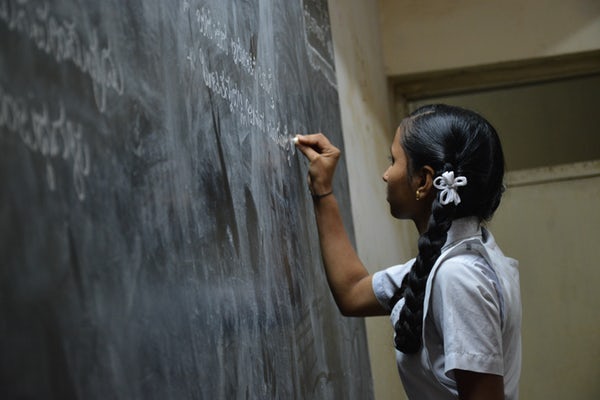
Was a reform movement in education which began in the 1880s and lasted over 60 years. The progressive movement emphasized learning by doing and the creation of curricula to suit children’s interests.

Refers to the act of taking something away, or separating something from something else, though not necessarily with a decrease in complexity.

Refers to the values, traditions, and infrastructure in each school. These characteristics govern how the school functions as an entity.

Is a collective, descriptive label for the social interactions and relationships among students — with each other and with their teachers — and teachers’ interactions with their peers and administrators. The ways students experience the school and culture: the ways teachers and administrators interact and collaborate.

Refers to a theory proposed by educational psychologist Howard Gardner, suggesting that certain areas of specialized intelligence become more developed than others. Includes 10 distinct areas of intelligence: visual/spatial, mathematical/logical, musical/rhythmic, kinesthetic, intrapersonal, interpersonal, naturalistic and existentialist.

Are two key terms referring to characteristics of a culturally responsive curriculum that ensures all students are welcomed and included in all aspects of the school while acknowledging their unique differences with respect and acceptance.

Is an education plan developed specifically for each student with a disability. In Canada and the United Kingdom, an equivalent document is called an Individual Education Plan. A well thought out Individualized Education Plan (IEP) represents some of the best personalized planning in education. The IEP lays out a year’s